Input
- What went in
- Research and identification: Spent approximately three to four months researching Kerala's folklore art forms to identify a tradition and practitioner for this edition of Friends of Thudippu. Artist coordination: Contacted Koya Kappad, introduced the Friends of Thudippu initiative, and coordinated the performance details, duration, requirements, and schedule. Date and venue planning: Finalised a suitable date based on the artist's availability and logistical requirements. Identified and confirmed Artiko in Mattancherry as the venue. Budget and expense planning: Identified expected expenses, including venue rental, artist remuneration, technical arrangements, refreshments, and other event-related costs. Promotion and communication: Collected the artist's details and photographs, designed a promotional poster, and shared the announcement through Thudippu's social media channels. Audience outreach: Personally invited friends, cultural practitioners, supporters, and interested members of the public. The team also visited and spoke with local cafés to spread awareness and encourage audience participation. Event logistics and hospitality: Coordinated evening tea and food arrangements for the artists, communicated venue and event details, and prepared the space for the performance. Event management: Welcomed the artist, team, and audience; coordinated seating and programme flow; and managed unexpected technical challenges during the performance. Documentation and follow-up: Captured photographs and videos of the event and acknowledged the artist's contribution, helping build relationships for future editions of Friends of Thudippu.
- Outside help
- Artist and performing team: Koya Kappad and his team brought their artistic expertise, knowledge, and generational experience of Daffmuttu and Arabanamuttu. Their explanations and audience interaction made the programme an educational experience as well as a performance. Venue support: Artiko, Mattancherry, provided the space for hosting the event. The venue's sound and lighting arrangements were also part of the event setup, although technical difficulties arose during the programme. Local outreach: Conversations with local cafés and personal invitations helped us reach people beyond our immediate network. Food and hospitality support: Arrangements were made at aikyam space to provide food and evening tea for the artists, supporting their comfort during the event.
- Time
- 3 hours
- Cost
- ₹60,000
Activity
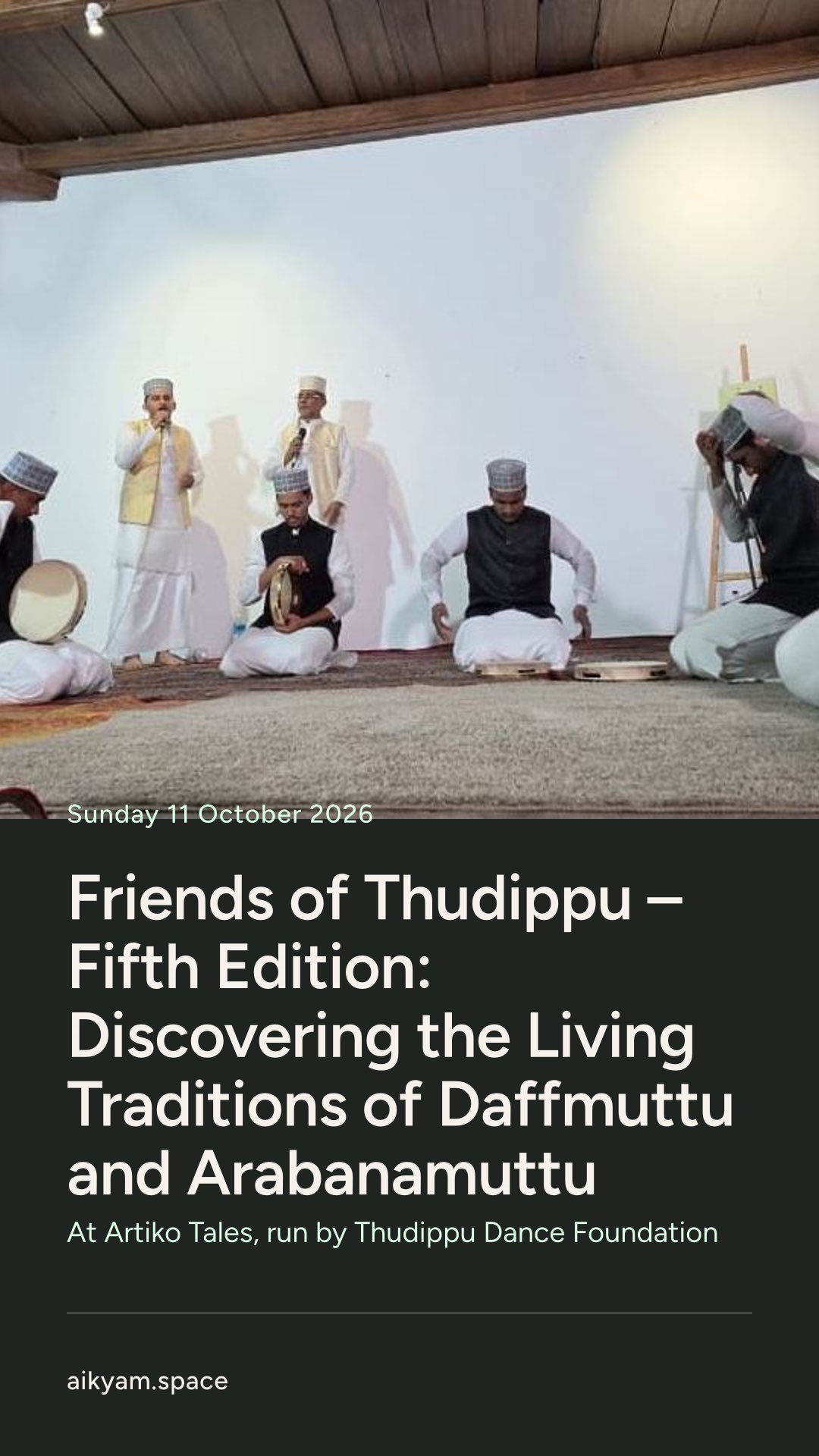
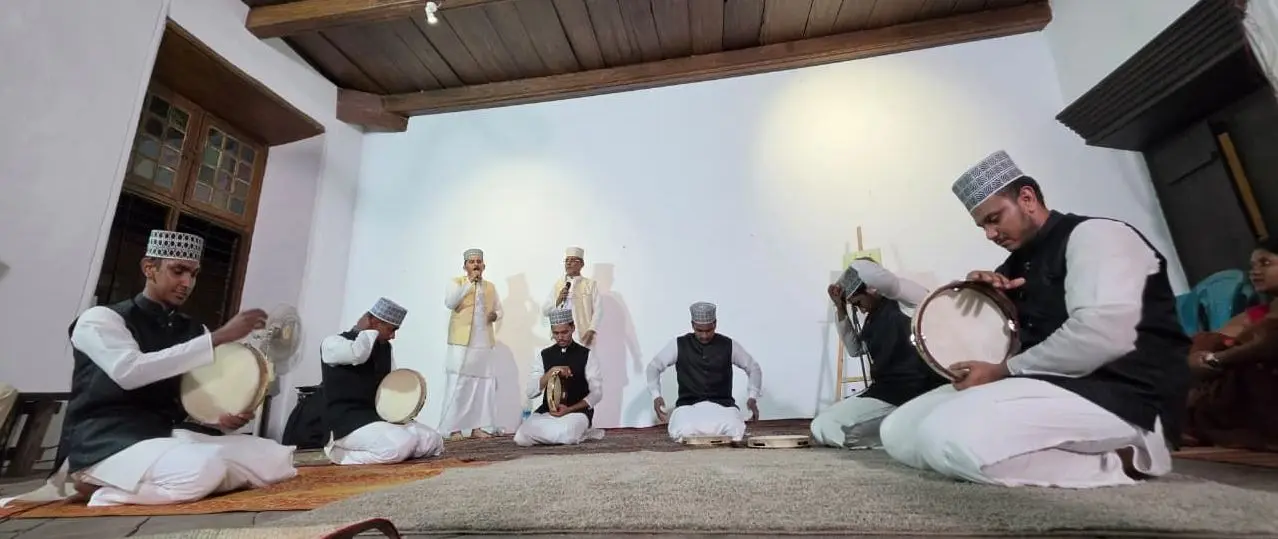
The fifth edition of Friends of Thudippu featured a rhythmic powerful performance of Daffmuttu and Arabanamuttu by Koya Kappad and his team at Mattancherry. The event brought audiences closer to the rich folklore and cultural heritage of Kerala, creating an experience that went beyond a conventional performance.
Koya Kappad, a seventh-generation practitioner from a family associated with these art forms, presented the traditions with remarkable energy and depth. The art forms were popularised in the Malabar region by the Allasammveetil family, a Yemeni family that arrived in the Kappad region of Kozhikode in the fifteenth century. The family has continued to pass these traditions down through generations, with the guru tradition inherited patrilineally. Koya Kappad represents the latest generation of this lineage.
One of the most meaningful aspects of the programme was the way Koya Kappad shared the history and context of the art forms alongside the performance. He introduced the audience to the rhythms and talam used in the traditions, demonstrated how they worked, and encouraged audience members to try them together. This interactive approach transformed the event into an engaging learning experience, allowing the audience to understand and participate in the art forms rather than simply watch them.
The performance created a strong impression on the audience, many of whom were experiencing these art forms for the first time. The audience response was enthusiastic, and the programme highlighted how live performance, storytelling, and interaction can help people connect with cultural traditions that may otherwise remain unfamiliar to them.
Organising this edition involved several months of research into Kerala's folklore traditions, identifying the art form and artist, coordinating the venue and performance requirements, preparing promotional materials, and reaching out to potential audiences. The team also managed event-day arrangements, artist hospitality, documentation, and technical coordination.
The event also brought important organisational learnings, particularly around sound and lighting. Despite challenges with the microphone, sound support, and the lighting provided at the venue, the team worked to ensure that the programme could continue. These experiences helped us recognise the importance of confirming technical requirements in advance and choosing venues with reliable basic sound and lighting facilities.
Friends of Thudippu was created to provide a platform for Kerala's rich art forms and the communities and practitioners who sustain them. This edition reaffirmed our belief that preserving cultural heritage requires more than documentation; it also requires creating opportunities for artists to perform, share their knowledge, and connect with new audiences. We see this as an important responsibility towards sustaining the living cultural heritage of our state.
Outcome
First-time exposure: Approximately 90% of the audience experienced Daffmuttu and Arabanamuttu for the first time, introducing these traditions to a new audience.
Increased cultural understanding: The artist's explanations helped the audience understand the history, traditions, and cultural context of the art forms.
Active participation: Audience members were introduced to the rhythms and talam and encouraged to try them, making the performance interactive.
Positive audience response: The audience showed enthusiasm and appreciation for the performance.
A platform for traditional practitioners: The event gave an experienced practitioner an opportunity to share his knowledge and perform for a wider audience.
Strengthening cultural preservation: The programme reinforced Friends of Thudippu's role in connecting Kerala's community-preserved art forms with contemporary audiences.
Organisational learning: The experience helped the team identify improvements needed in venue selection, sound management, and technical planning.
(Participants told us)
Learnings
Our team communicated and followed up on the technical requirements one week before the event and checked the setup before the audience arrived. However, during the performance, the technician from the external sound and lighting team arranged through the venue was unavailable, leading to sound and microphone issues. The lighting also differed from our request for warm lighting.
This experience taught us that technical support must be available throughout the performance, not just during setup. For future editions, we will prioritise venues with reliable sound and lighting facilities and ensure that a dedicated technician is available for the entire event when external teams are involved.
Run this activity yourself. You are free to copy, change and share this write-up, as long as you credit aikyam space. Photos are not included. (Creative Commons licence CC BY 4.0)