LifSkool: last in-person session and the SPARK ChallengeOpening doors: first school outreach togetherUnderstanding each other at LifSkoolGuided line practice for Kantha stitch precisionBuy unique Tote Bag with Constitution of India Preamble(opens in a new tab)
aikyam spaceSubscribe
Aparna NS

Aparna NS

For Aparna, loving an artform to the point of constant, perpetual self-exploration is a way of life.

What Aparna NS did here
Show all 54 sessions
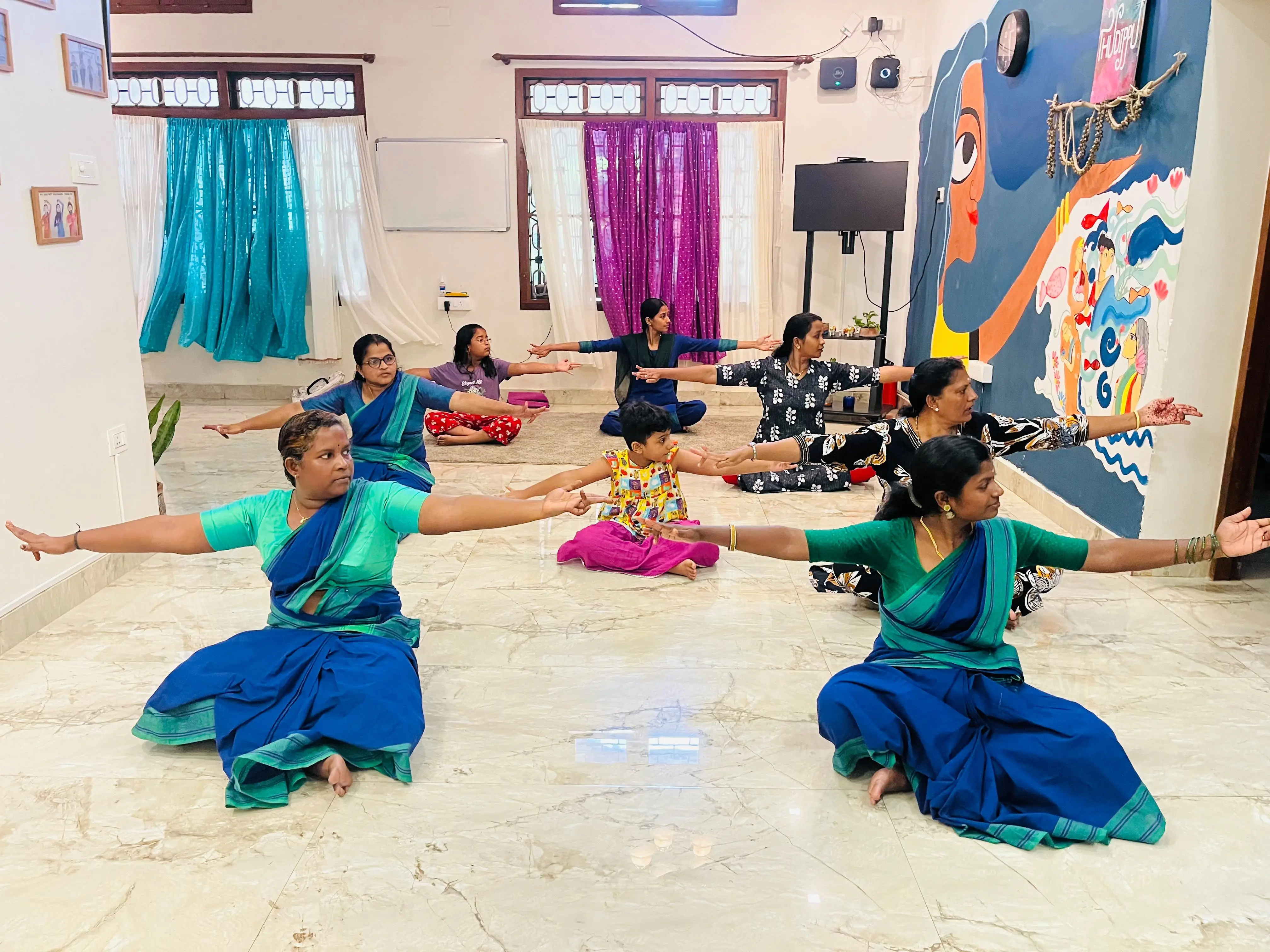
  • A group of people, including adults and a child, are sitting on a tiled floor indoors with their arms extended horizontally to the sides. They are arranged in rows, facing forward, and appear to be participating in a coordinated activity. Most are wearing sarees in shades of blue and green, while one child wears a colorful patterned top with pink pants. The room has large windows with curtains in blue, white, and purple, a whiteboard mounted on the wall, and a television on a stand. One wall features a large colorful mural with painted figures and decorative elements.

    Introducing eye, neck and eyebrow exercises

    On Sunday, most students in the adults' batch were absent, so we used the session to introduce new exercises for the eyes, neck, and eyebrows. The students who came were eager to learn. Some movements felt hard at first, but they kept trying. In Bharatanatyam, eye and neck movements are important for expression and technique. Practising these exercises helps students become familiar with them and control them better, which makes their dancing clearer and more confident.
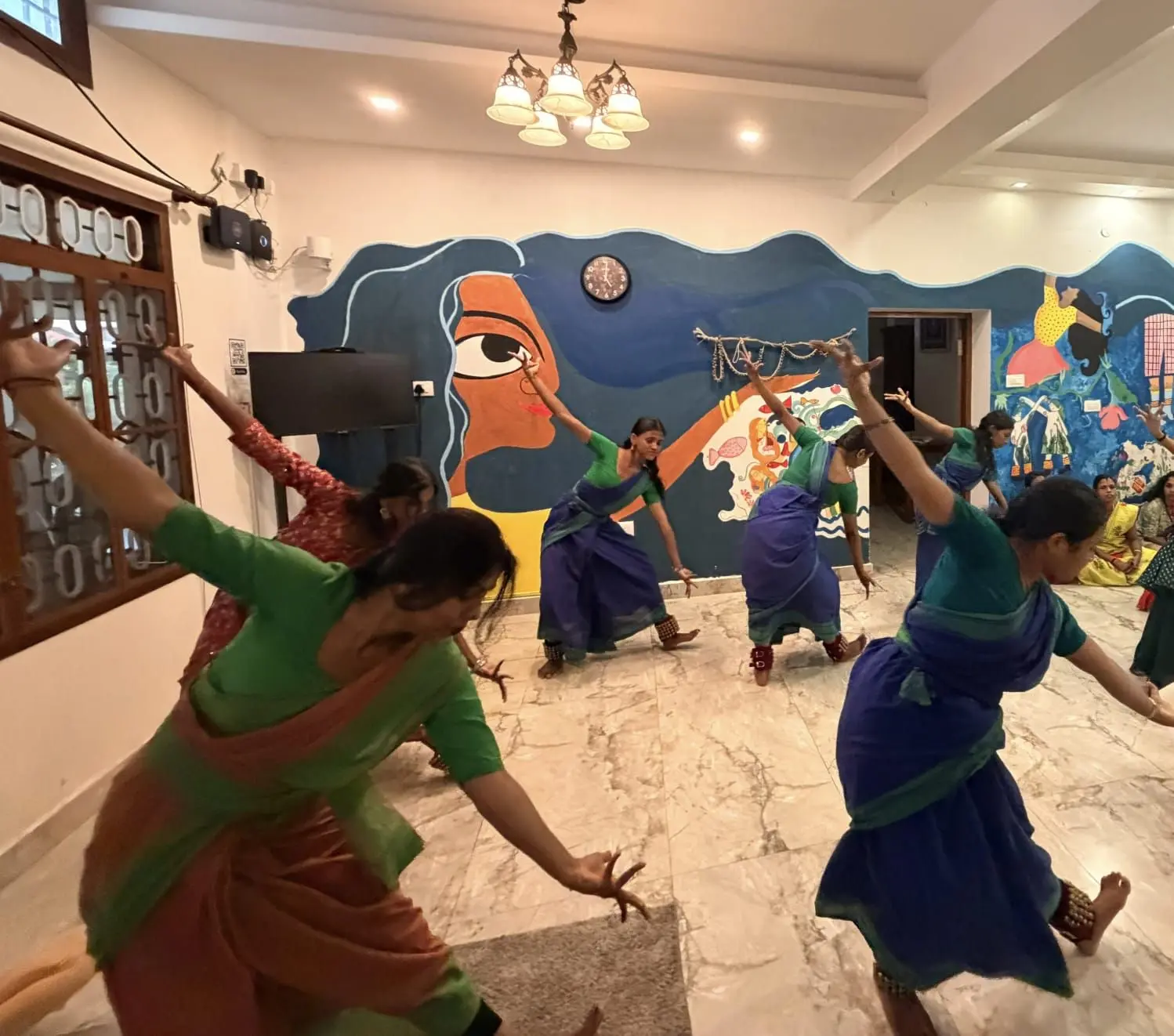
  • A group of women perform a traditional dance indoors, wearing green blouses and blue or red sarees, with their arms raised and bodies in motion. They are positioned in front of a large colorful mural painted on the wall, which features stylized faces and figures. A clock hangs on the wall above the mural, and a chandelier hangs from the ceiling. To the left, a window with a wooden frame is visible, and a television screen is mounted on the wall near the mural. Other people are seated along the right side of the room, watching the performance.

    Practising basic Adavus and exploring Paraval Adavu

    In the second batch, students practised the basic Adavus and went through the detailed notes for the second Paraval Adavu. They then explored a more advanced movement sequence, building on the Adavus they had learned earlier. This practice helped students pay closer attention to body coordination and how their hands and legs move together. As they worked through the steps, they became more aware of how their bodies move.
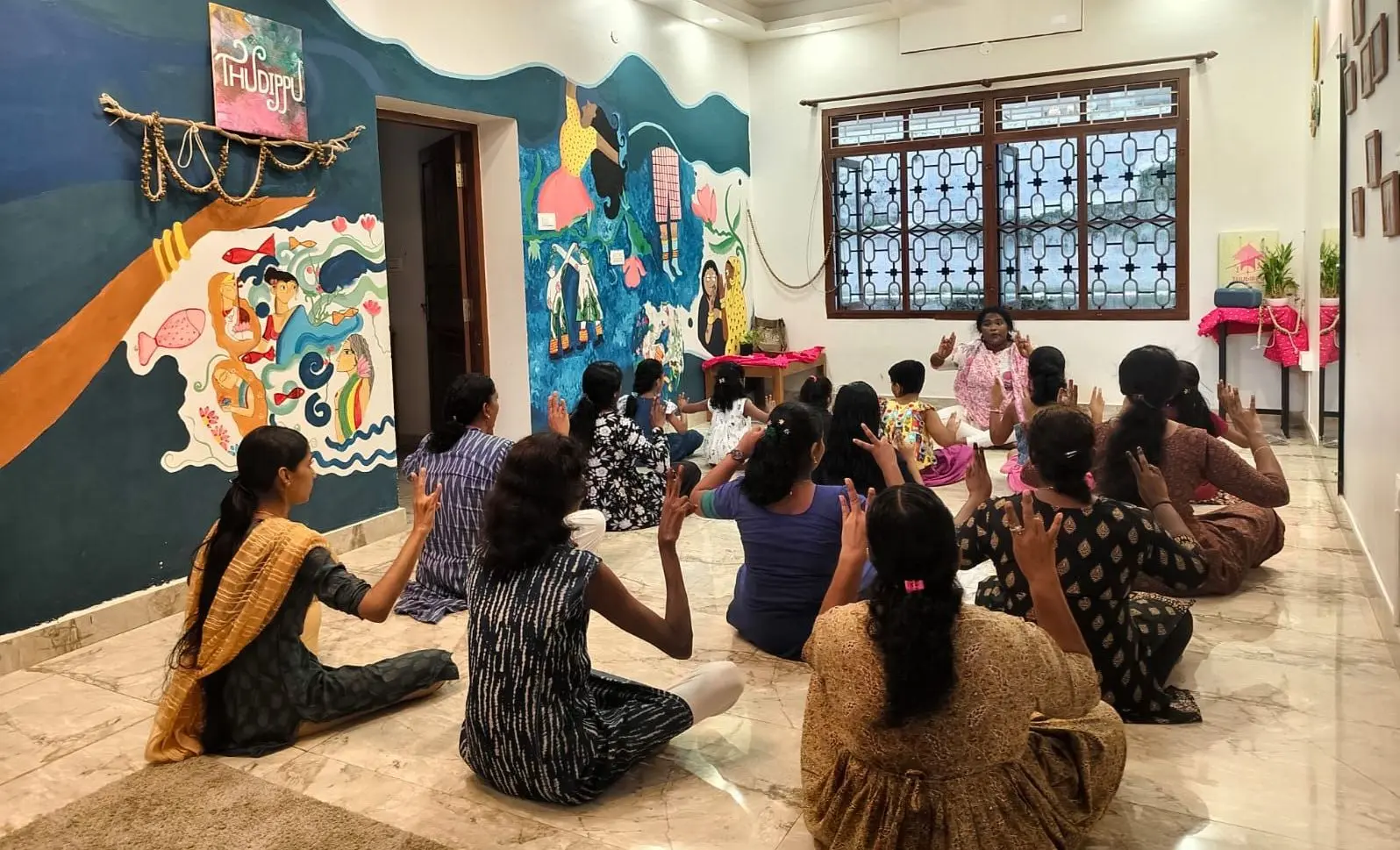
  • A group of people sit cross-legged on a tiled floor in a room with painted walls, facing a person who is seated at the front and gesturing with raised hands. The participants, mostly women and children, mirror the gesture with their own hands raised. The walls feature colorful murals, including a large painted hand and figures, and a doorway is visible on the left. A window with a decorative grille is on the back wall, and a small table with items on it stands to the right.

    Learning together across generations

    Today, the children's batch and the women's batch came together for class. Some of the children's mothers are part of the women's batch. This was a special chance for families to share the dance space. We combined the children's and women's batches for a shared class. We guided the group through activities everyone could take part in. We guided students of different ages through Mudra practice. We practised Thalam together. Together, the students practised Mudras and Thalam. Learning side by side gave children and adults a chance to share the experience, observe one another and connect through dance.
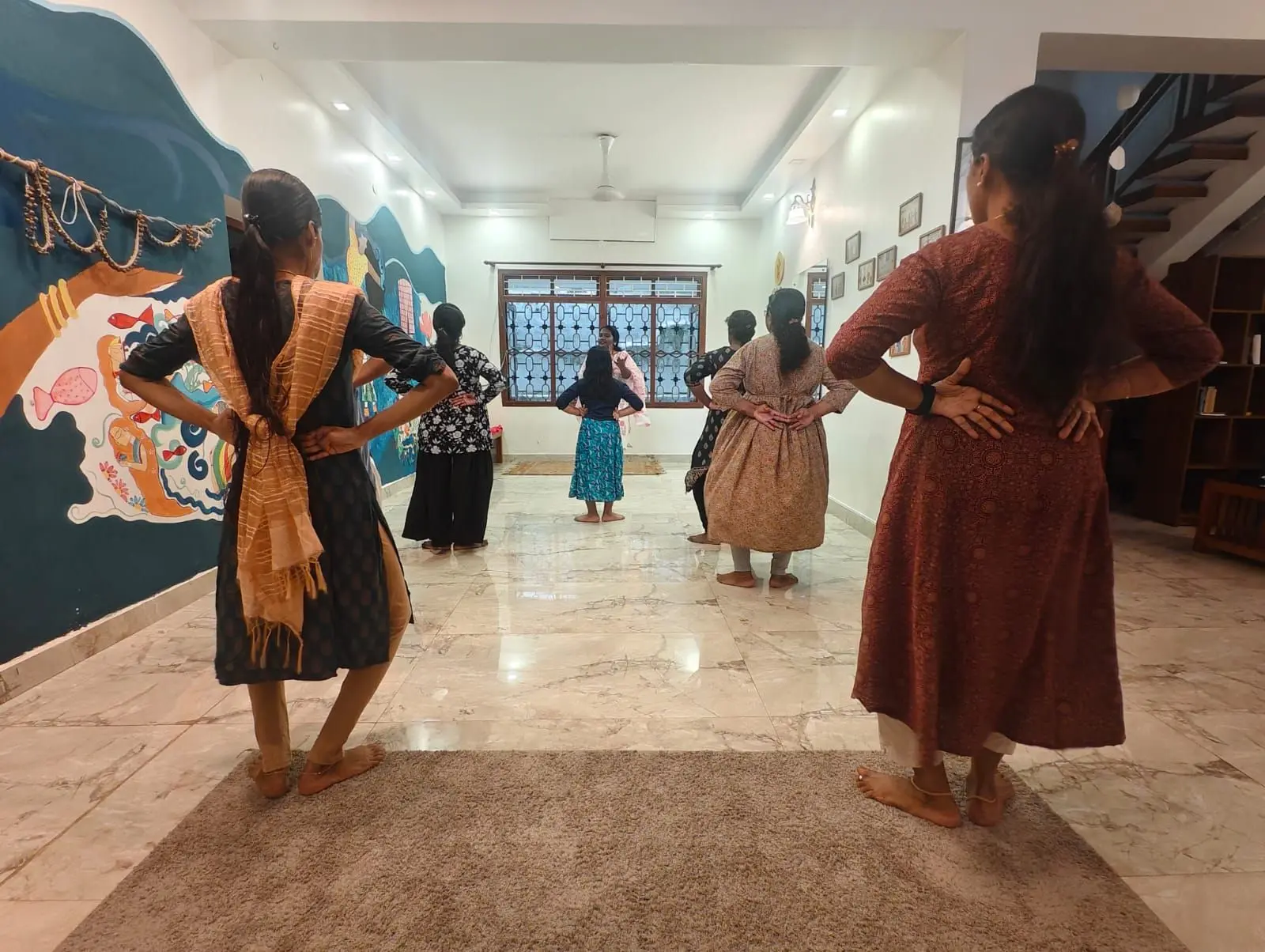
  • A group of people stand in a line inside a room with tiled floors and white walls, all facing away from the camera with their hands on their hips. On the left wall is a large painted mural with blue and orange colors and decorative elements hanging above it. At the far end of the room, a window with a grid pattern lets in light, and a person stands near it. To the right, framed pictures hang on the wall above a wooden bookshelf, and a staircase is visible in the background. A light-colored rug covers part of the floor in the foreground.

    Building stamina through continuous Nattadavu practice

    Our women's batch, aged 30+, focused on building stamina in today's class. They practised all the Nattadavus without stopping. They did this at all three speeds. We encouraged them to maintain movement and rhythm through the sequence. The students felt tired, but they kept going. They completed the practice without giving up.
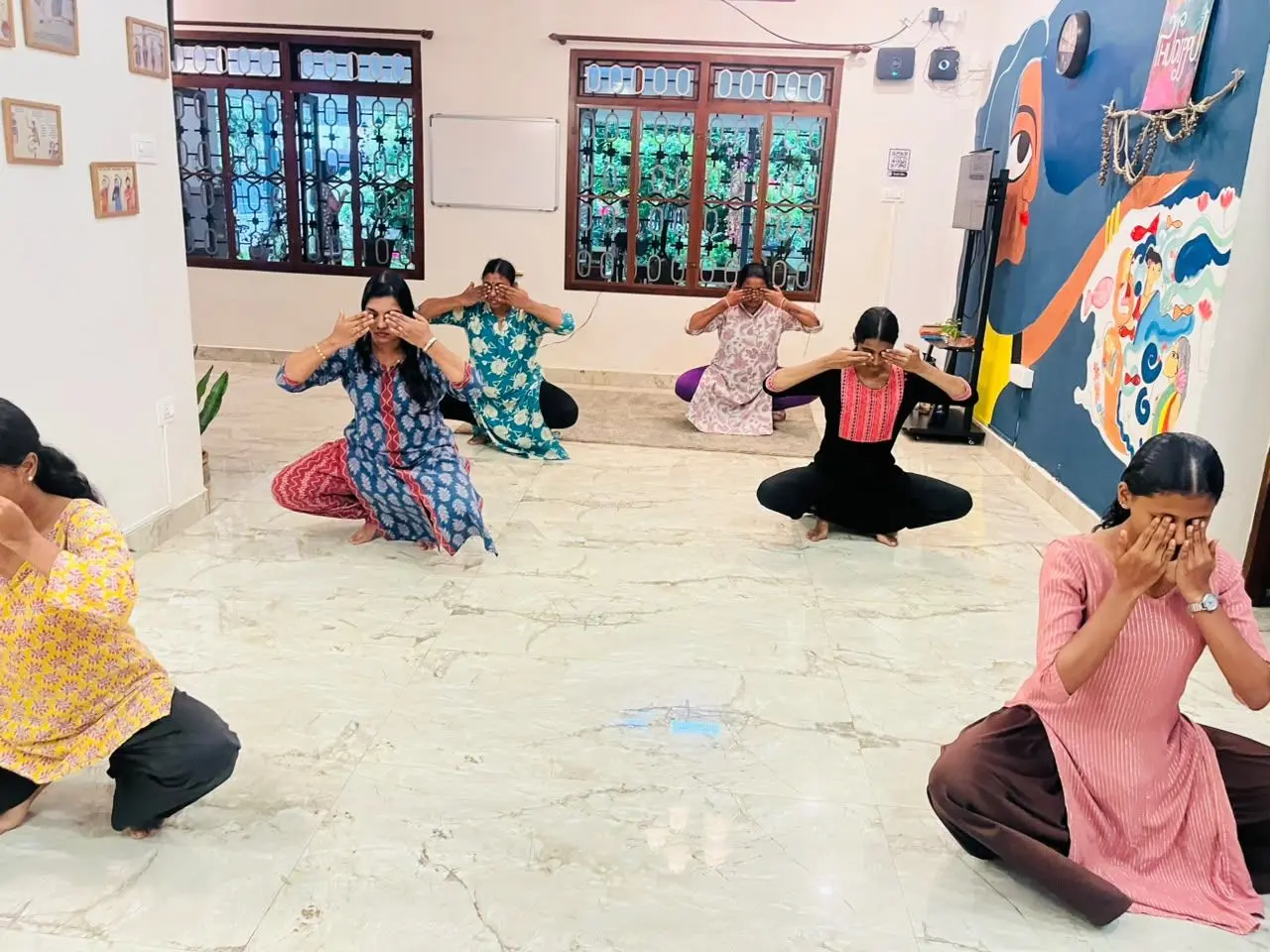
  • Six women are sitting on a tiled floor in a room, each with their hands covering their eyes. They are arranged in a loose semi-circle facing forward. The room has two large windows with decorative grilles, a whiteboard on the wall, and a colorful mural on the right side. The women are wearing various traditional outfits in different colors and patterns.

    Beginning performance preparation for the seniors' batch

    We introduced a dance item to the seniors' batch in preparation for their performances in February. Preparing students for a performance takes time, practice and continued learning, so we are starting early. Regular rehearsal will help the students become familiar with the item and work towards performing it with confidence and accuracy.
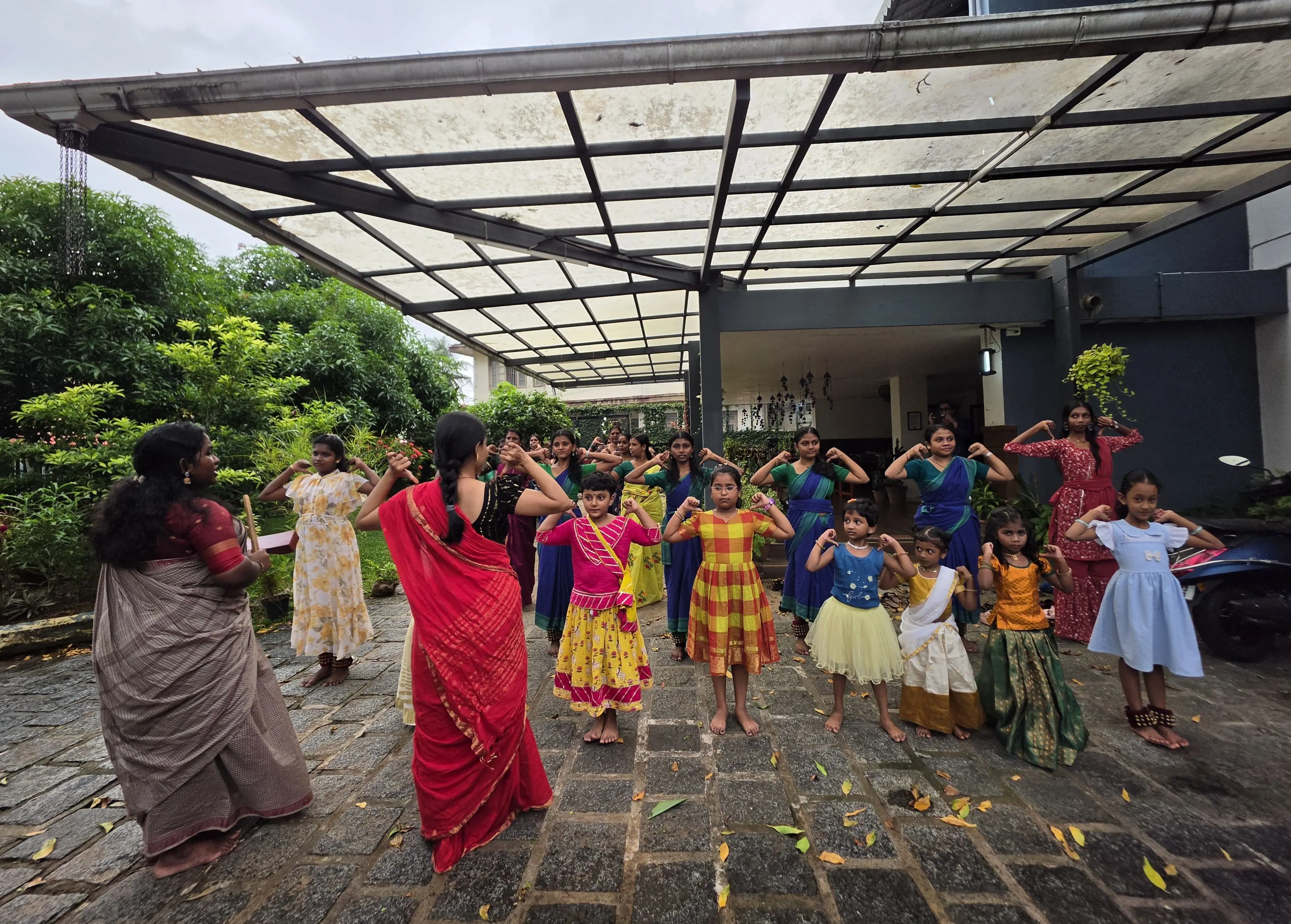
  • A group of women and children stand outdoors on a paved area beneath a translucent roof structure, posing with their hands raised near their heads. They are dressed in colorful traditional clothing, including sarees and dresses in red, yellow, blue, and white. Behind them is a building entrance with greenery visible to the left.

    Dance Together Day: celebrating a new milestone

    Students from our batches came together for Dance Together Day. They met, danced, and celebrated as one community. This brought together students from different batches and age groups. Students aged 40 and above danced alongside children as young as three years old. It was special to see generations sharing the same dance space. All four teachers were present at the dance gathering. Many students dressed for the occasion. Some students could not attend, but those who came brought plenty of joy and energy. We also celebrated students who were ready for the next level. They wore the chilanka (dance bells) for the first time. Teachers tied the bells for the students, who then danced wearing them. The day felt like a joyful meetup, as students from different batches and age groups shared the dance space.
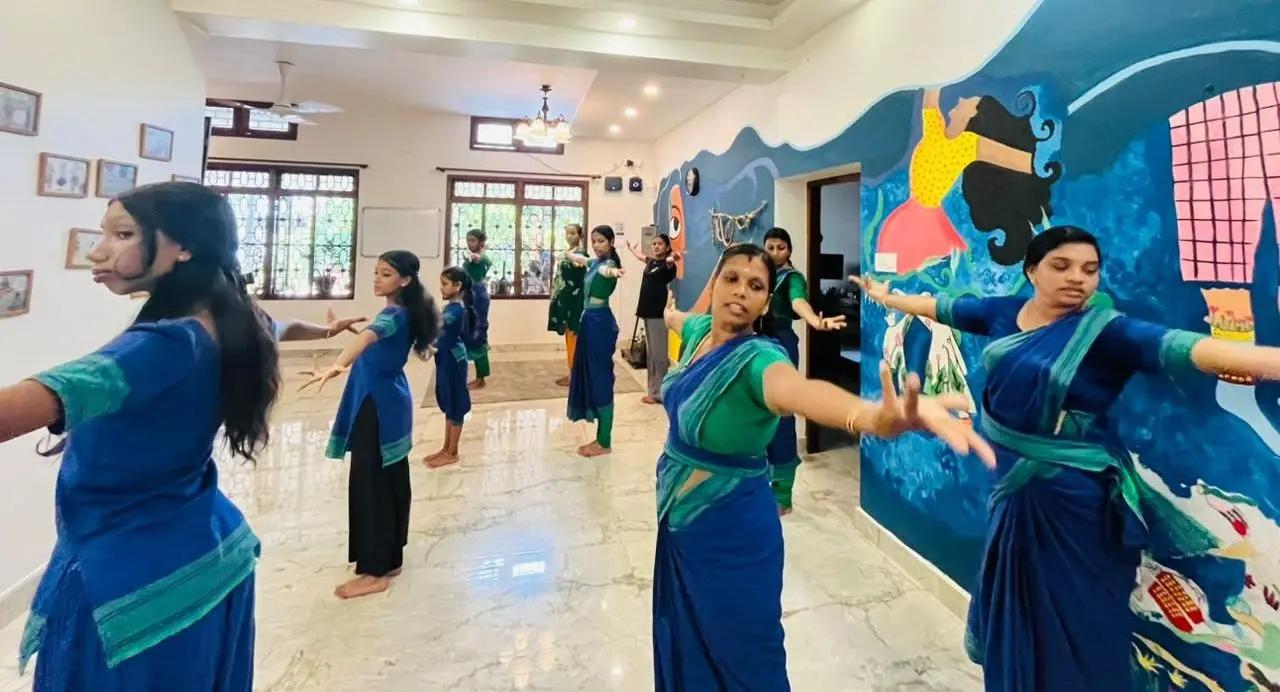
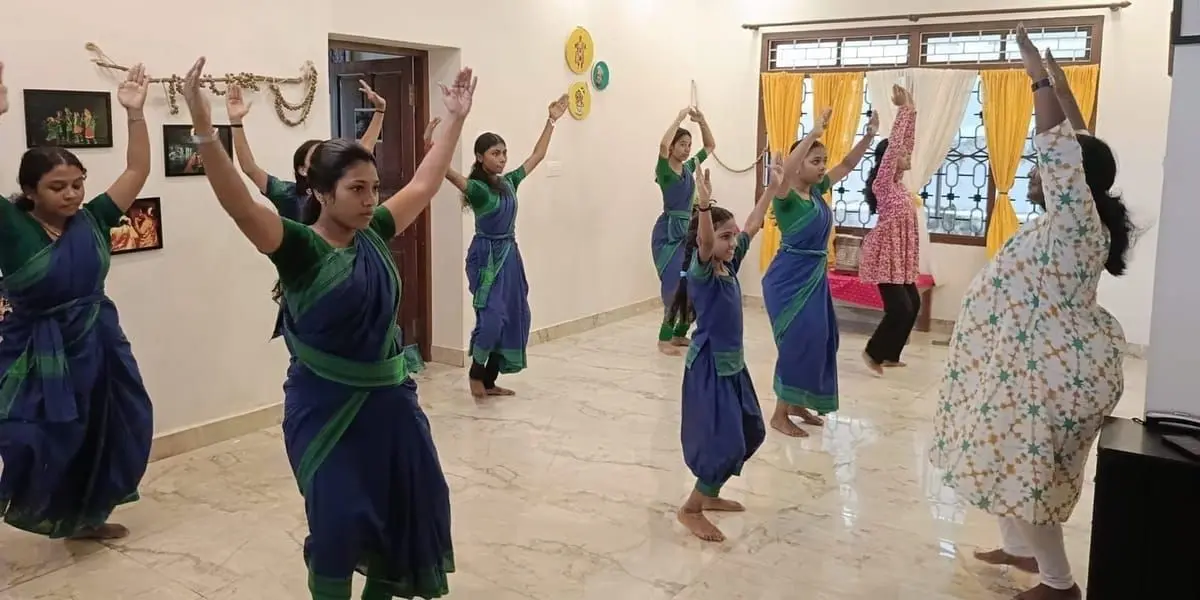
  • A group of women and girls in matching blue and green traditional outfits perform a synchronized dance with arms extended in a brightly lit room with a large mural on one wall.

    Learning Thalam, Mudras and Adavus

    Students practised basic Thalam and Mudras today. They explored how Mudras are used in dance to express different meanings and emotions. They also revised basic Adavus to strengthen their understanding of the steps and rhythm.
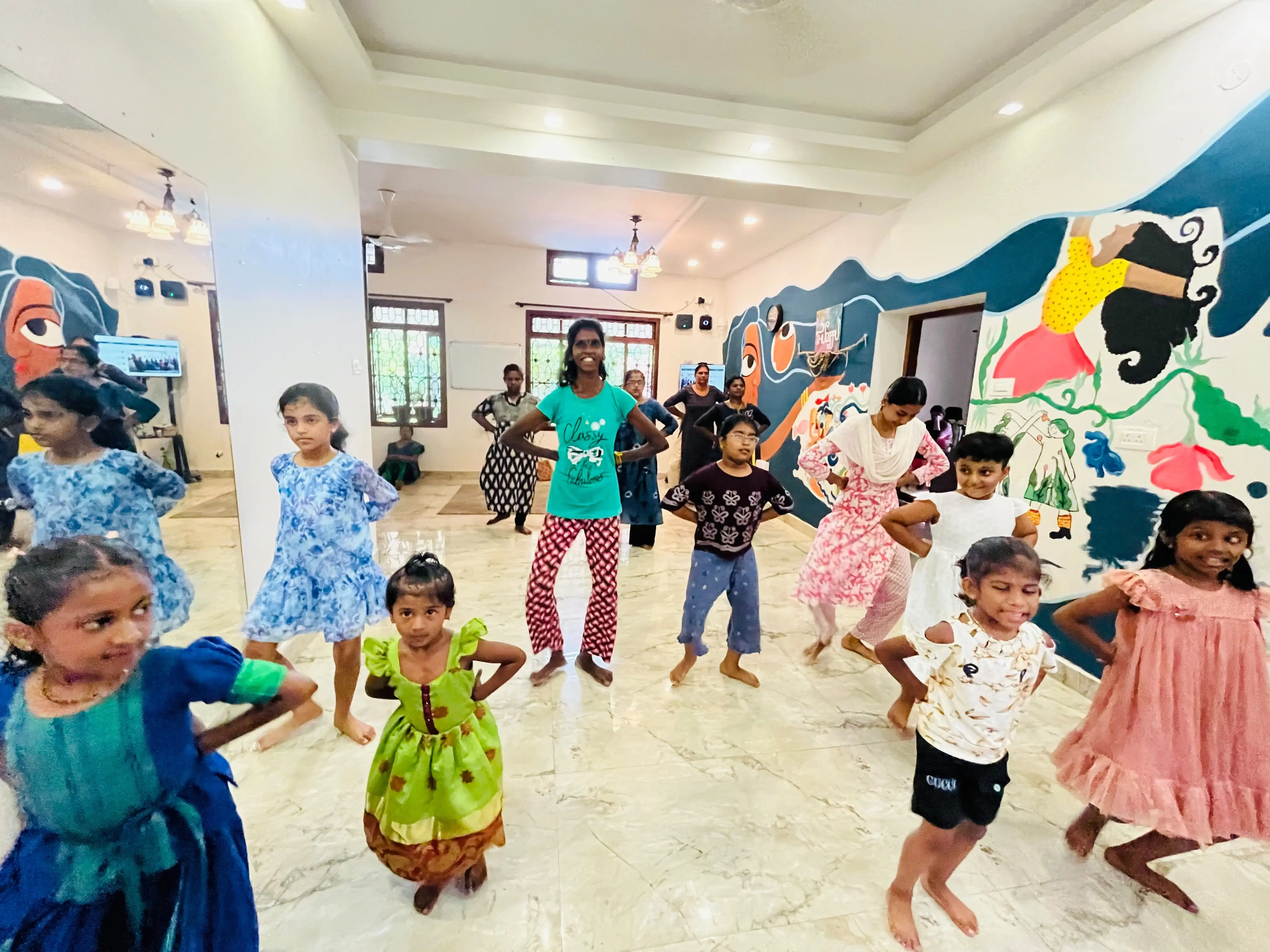
  • A group of children and adults are gathered in a brightly lit indoor space with tiled floors and white walls, some standing in a loose circle while others move around. A woman in a green top and patterned trousers stands near the center with her hands on her hips, smiling. Several children wear colorful dresses and casual clothing, with some barefoot. In the background, more adults stand near windows and doorways, and a large colorful mural covers part of the wall on the right. A screen is mounted on a stand to the left, and ceiling fans and lights are visible overhead.

    Building co-ordination, confidence and patience through Adavu practice

    Today in our kids batch, children stayed engaged throughout the practice. They made a consistent effort to understand and perform the movements. Learning Adavus takes repetition, co-ordination, concentration and patience. As children become more familiar with the movements, they learn to co-ordinate different parts of their bodies. They also become more aware of how they move. Dance practice is about more than learning steps or perfecting technique. It gives children an opportunity to develop body-mind co-ordination, concentration, patience and perseverance.
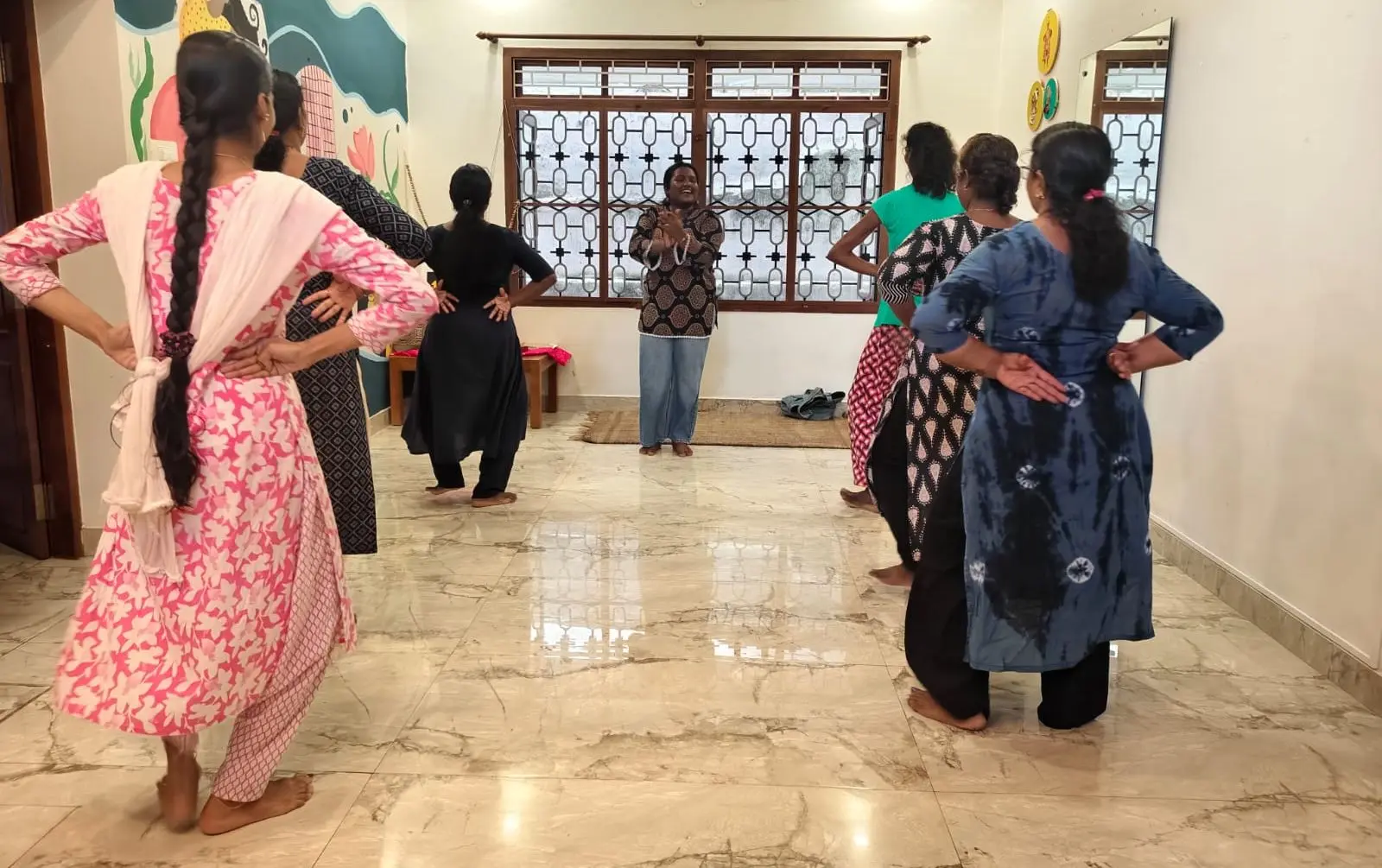
  • A group of women stand in a circle inside a room with a tiled floor, facing inward toward a woman standing near a window who appears to be leading them. The women have their hands on their hips and are barefoot. One woman in the foreground wears a pink patterned outfit with a long braid and a light scarf draped over her shoulder. Others wear various patterned tops and pants. A mirror hangs on the wall to the right, and a colorful mural is visible on the left wall. A small rug lies on the floor near the center.

    A new dance batch for women 30+

    As interest in our regular batch grew and new admissions continued, we started a new batch so we could welcome more students. The batch brings together women aged 30 and above, each arriving with enthusiasm and a strong commitment to learning dance. The faculty find the classes rewarding. The faculty value the interest and hard work the students bring to every class. For many of these women, the class is more than a place to learn dance. It is also a joyful space to explore a long-held dream. The enthusiasm across the batch reflects how worthwhile it can be to begin or return to dance at any age.
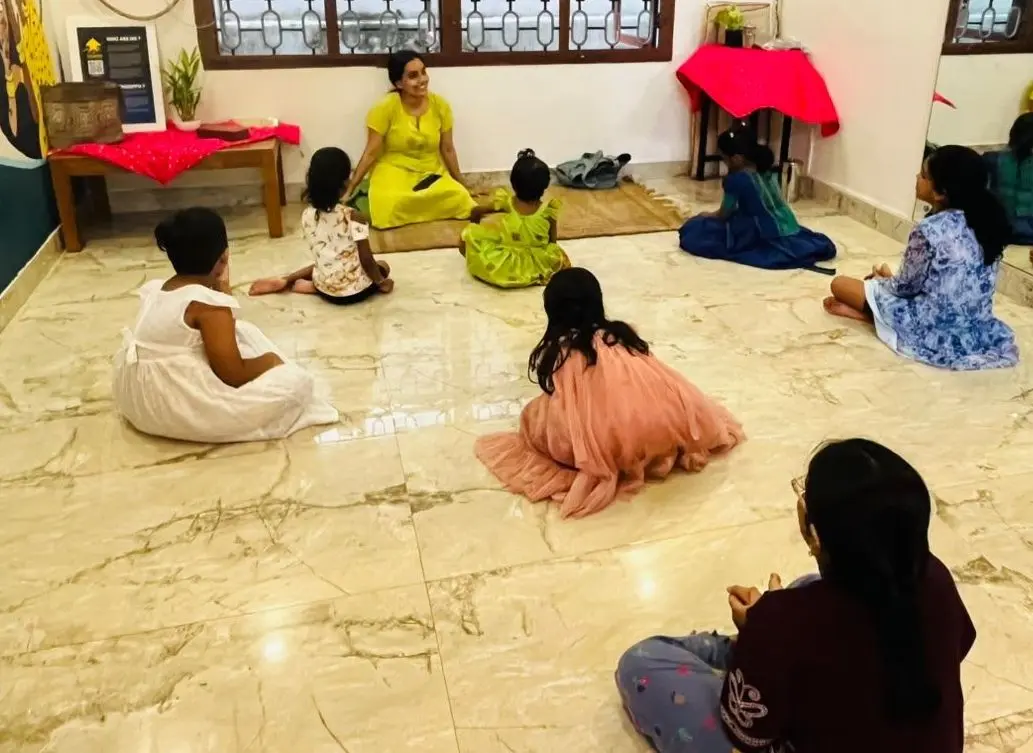
  • A woman in a yellow outfit sits cross-legged on a mat facing a group of children who are seated on a tiled floor in a circle around her. The children are wearing various colored dresses and traditional clothing. In the background, there is a low table covered with a red cloth holding a framed item and a small plant, and another table draped with a red cloth stands against the wall. A window with a decorative grille is visible above the woman.

    From play to learning: creating space for children to grow

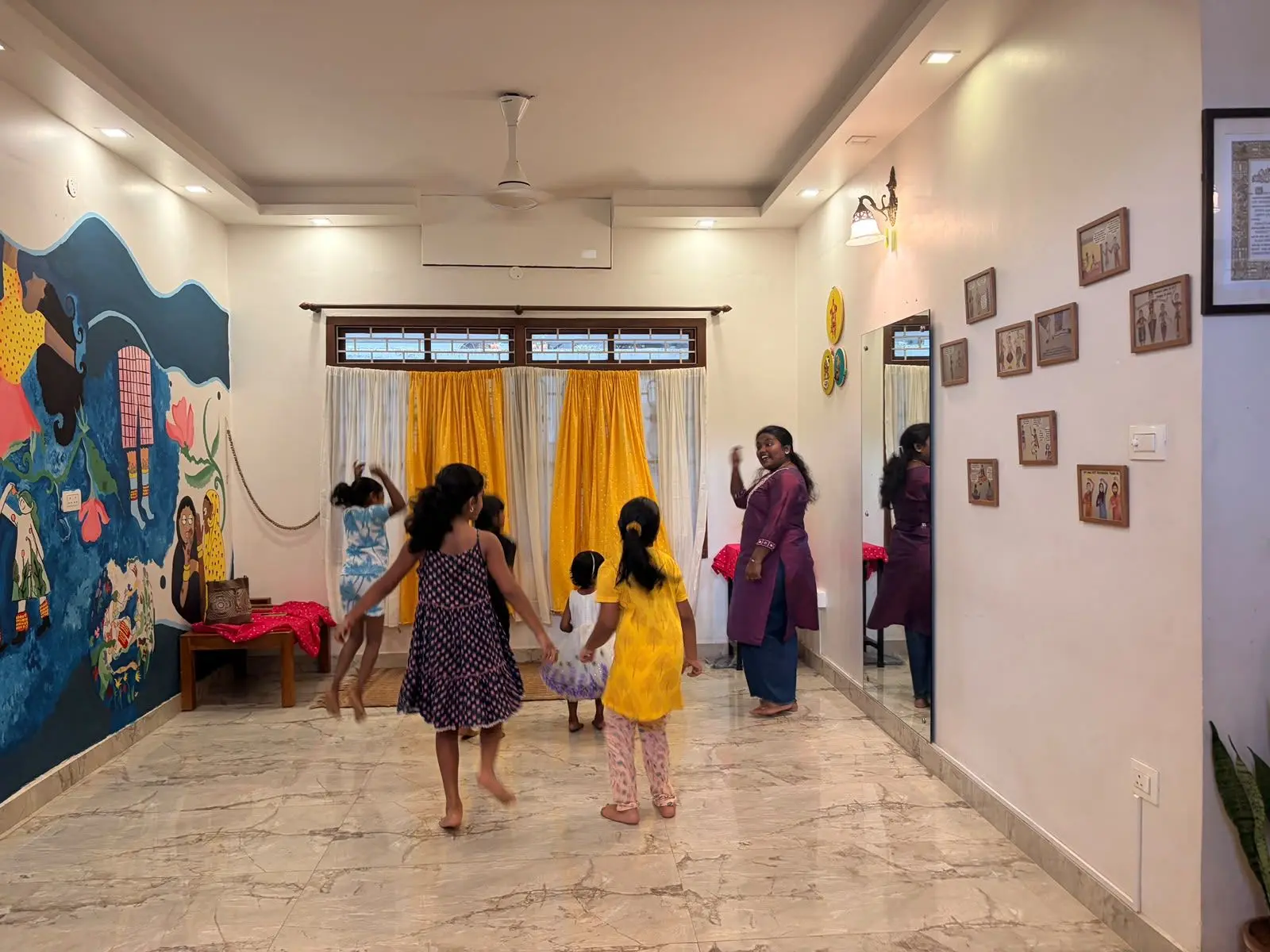
    The children arrived for Sunday's dance class in a playful mood, so we began by giving them some time to play before the structured session. They took part eagerly in the muscle-strengthening exercises before we started practising Adavus. The children stayed focused throughout the practice and kept trying to understand and perform the movements. Learning Adavus takes repeated practice, co-ordination, concentration, and patience. As children grow familiar with the movements, they learn to make different parts of their bodies work together and notice how they move.
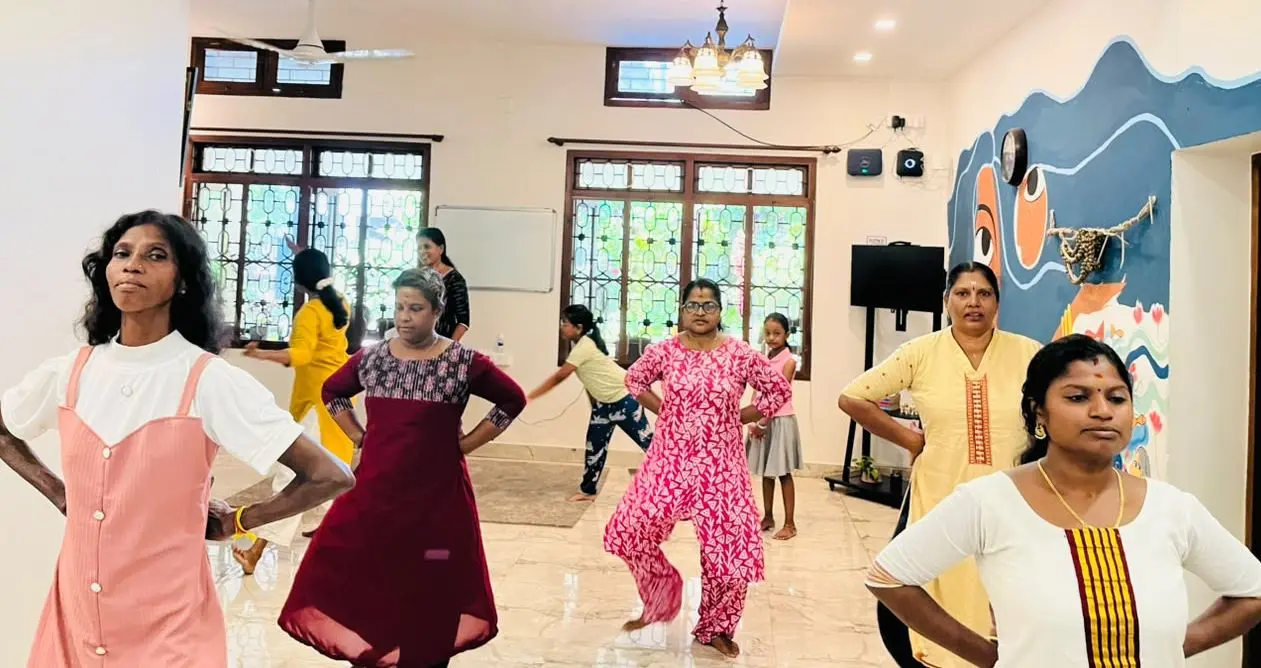
  • A group of people, mostly women and girls, stand in a room with their hands on their hips, looking forward. They wear colorful traditional clothing, including dresses and salwar kameez in shades of pink, maroon, yellow, and white. Behind them, a woman in a yellow outfit stands near a window with stained glass panels, while another woman in black stands near a whiteboard. A young girl in a grey dress stands near the center. The room has tiled floors, ceiling fans, and a large blue wall mural with abstract shapes and a painted face. A television on a stand and wall-mounted speakers are visible against the back wall.

    Building rhythm and co-ordination through revision

    On Sunday, most students were absent, so I used the class to revise Adavus and Mudras and introduced basic Chollu and Thalam. This helped me realise the importance of changing my lessons to fit the students' needs and giving them enough time to develop rhythm and co-ordination. I learned that even a small class can be a valuable opportunity to observe and support each student.
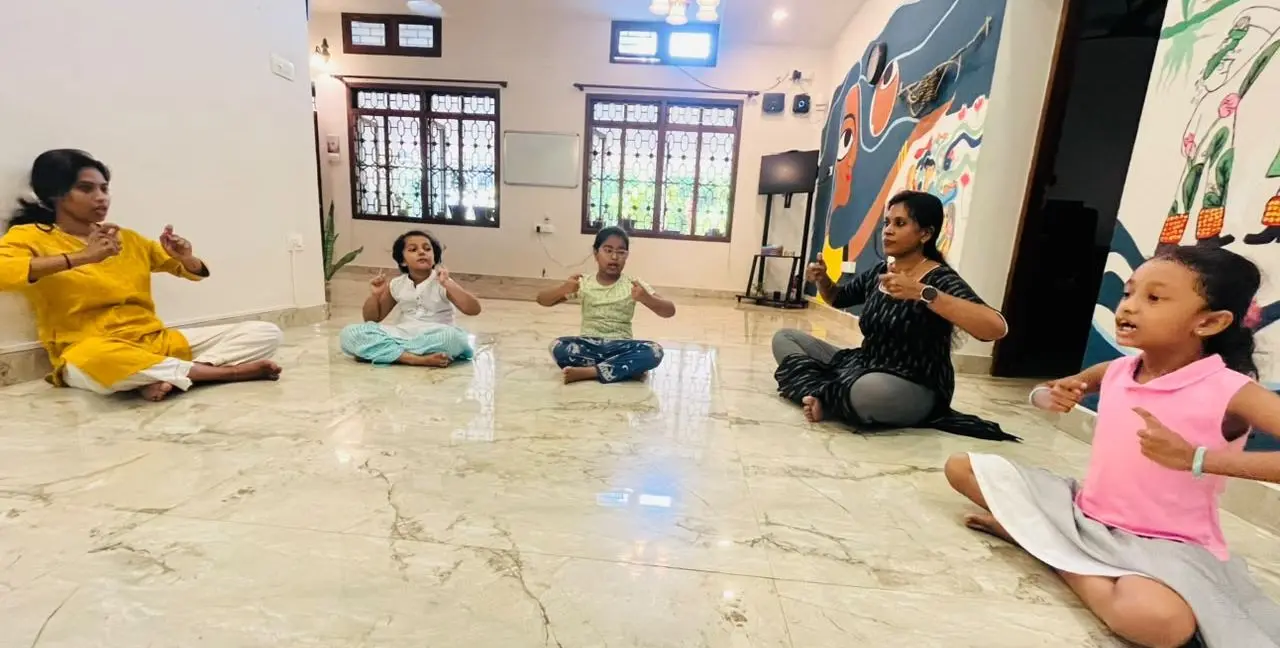
  • Five people sit cross-legged on a polished floor inside a room, arranged in a loose circle. On the left, an adult in a yellow top and white pants sits with hands raised near the chest. Next to them, a child in a white top and light blue pants mirrors the pose. In the center, another child in a light green top and patterned pants sits with hands raised. To their right, an adult in a black patterned top and grey pants sits with hands raised and holds a small yellow object. On the far right, a child in a pink sleeveless top and grey skirt sits with hands raised. Behind them, large windows with decorative grilles let in daylight, and a wall features a colorful painted mural. A black stand with equipment stands near the back wall.

    Breaking down Nattadavu: building co-ordination step by step

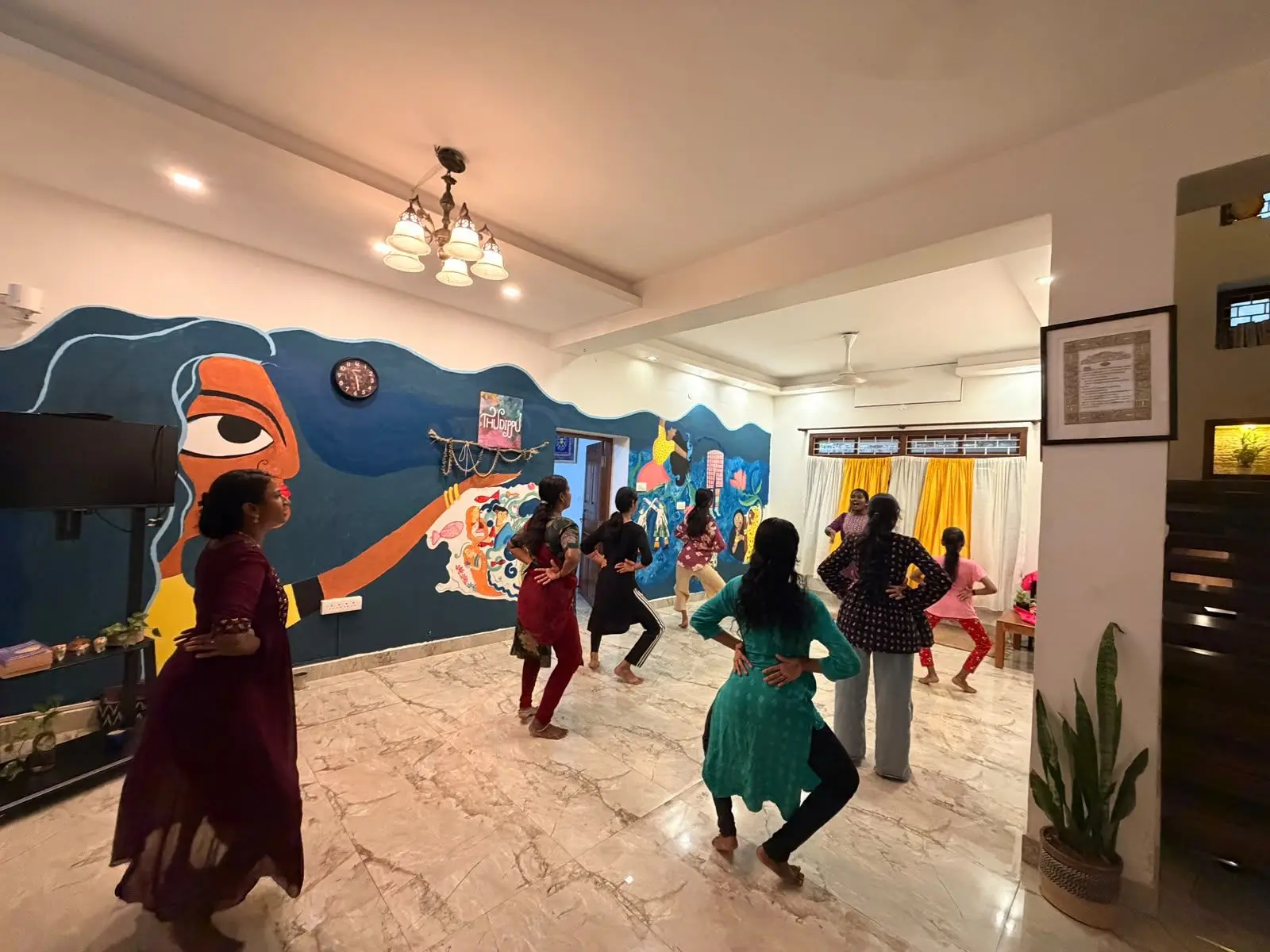
    The students found the adavu Nattadavu difficult to understand, so I started with the leg movements separately. Once the steps were familiar, I added the hand movements. The students struggled to co-ordinate both movements at the second and third speeds, so I spent more time on the leg movements. This taught me that breaking down difficult movements into simple parts helps children learn more effectively.
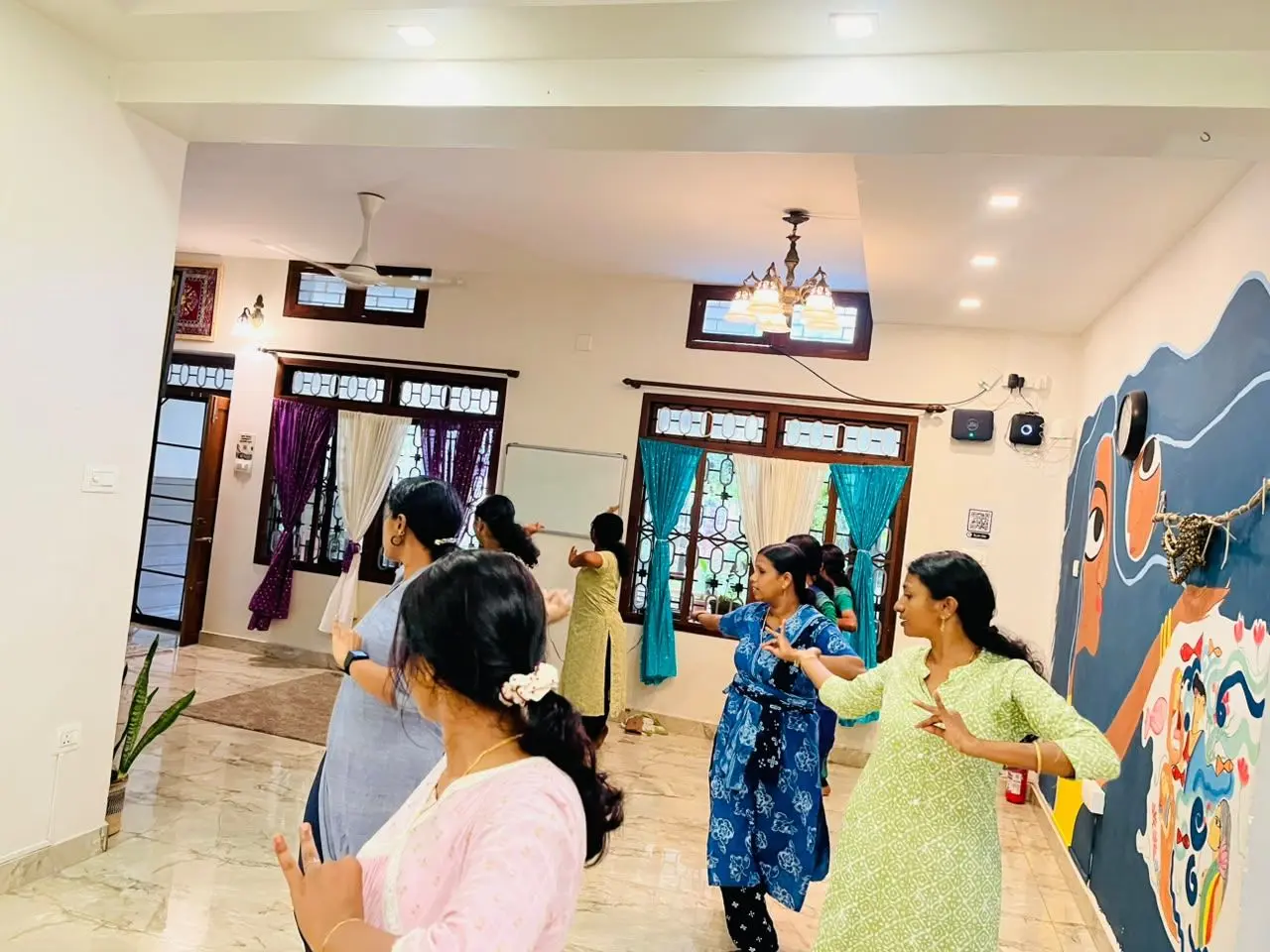
  • A group of women are gathered in a brightly lit room with tiled floors and white walls, practicing coordinated hand movements. Several women stand in a line facing a wall with a large mural, while others stand near windows with patterned glass and curtains. A ceiling fan and a chandelier hang from the ceiling, and a whiteboard is mounted on one wall. A potted plant sits in the corner near a doorway.

    Applying spatial awareness to Bharatanatyam

    The Sunday class focused on directions and spatial awareness. These are important parts of learning dance. The students practised the "Tha Thai Thai Tha" adavu. This is the third set of steps in Bharatanatyam. They faced an interesting challenge. I demonstrated the movements facing them. Many students tried to mirror my actions. But in this exercise, they often needed to move in the opposite direction. This caused confusion. There were mix-ups with right and left turns. We did not see these mistakes as a problem. We used them as a learning opportunity. We discussed what was happening and tried different approaches. We also practised repeatedly. Sometimes I turned around and demonstrated with my back to the students. At other times, they consciously tried the opposite side. This helped them understand the directions better. Slowly, the students began to figure it out. By the end of the session, they moved with more confidence and awareness. We learned that learning dance is not just about memorising steps. It is also about understanding space and directions. It is about learning by trying things and fixing mistakes.
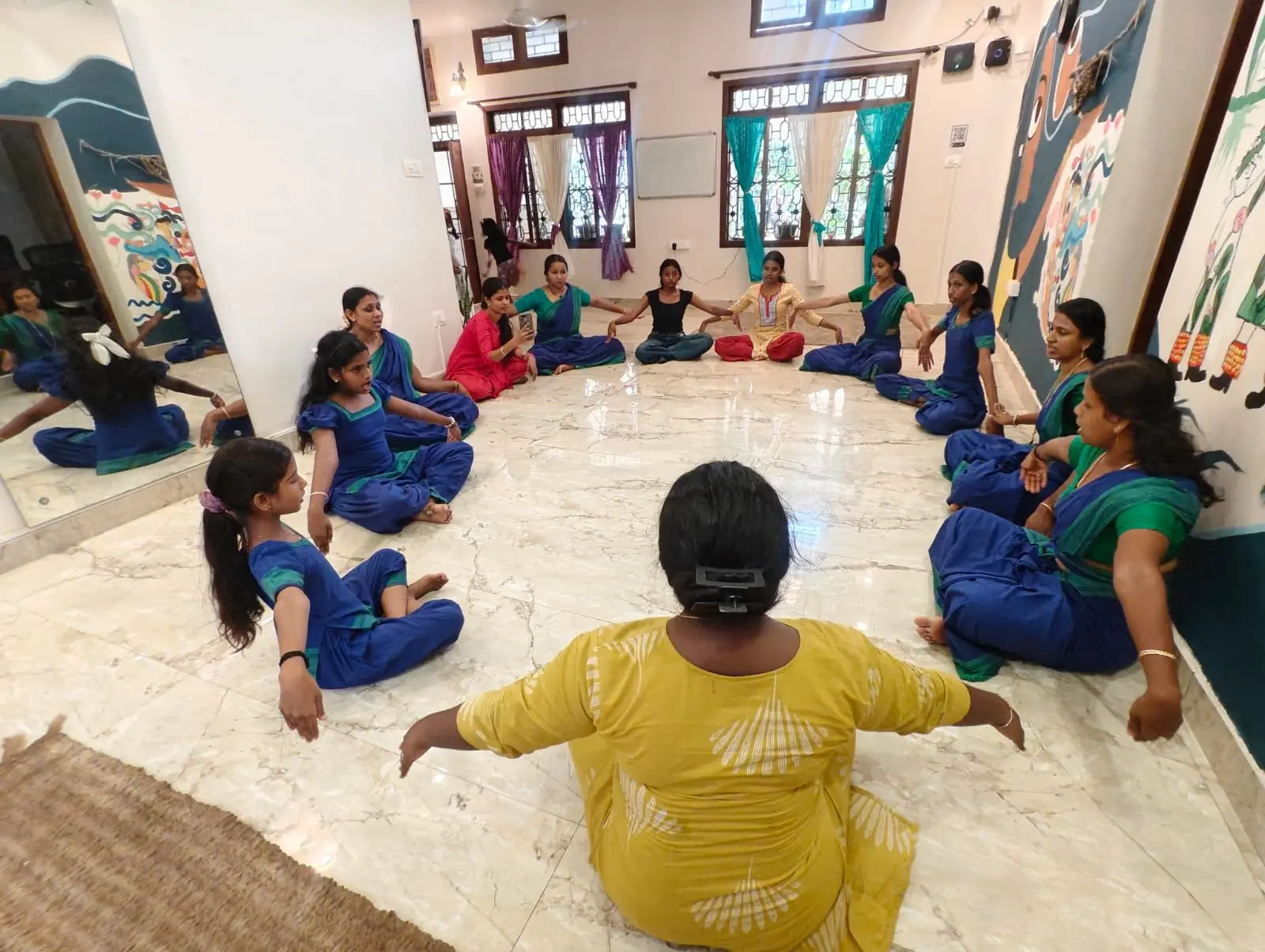
  • A group of people sit in a circle on a polished floor inside a room, facing inward with their arms extended toward one another. One person in a yellow top sits with their back to the camera at the front of the circle, while the others, mostly in blue and green outfits, are arranged around them. A mirror on the left wall reflects part of the group, and windows with curtains are visible in the background.

    Aparna introduces Mudras and Sanskrit to students

    On Saturday, Sept. 12, 2026, Aparna focused on the fundamentals. She led the students through Thattadavu and Nattadavu. She explained why these basic steps build a strong foundation in dance. After working through the adavus, the students moved on to the Mudras. The movements interested them, but remembering and pronouncing the Sanskrit names proved difficult. Some students hesitated when the unfamiliar words did not come easily. Aparna had a simple solution: repetition. She kept encouraging them with the same words again and again: "Guys, repeat, repeat and repeat. You will remember." She did not expect them to get everything right at once. She gave them space to practise, make mistakes and try again.
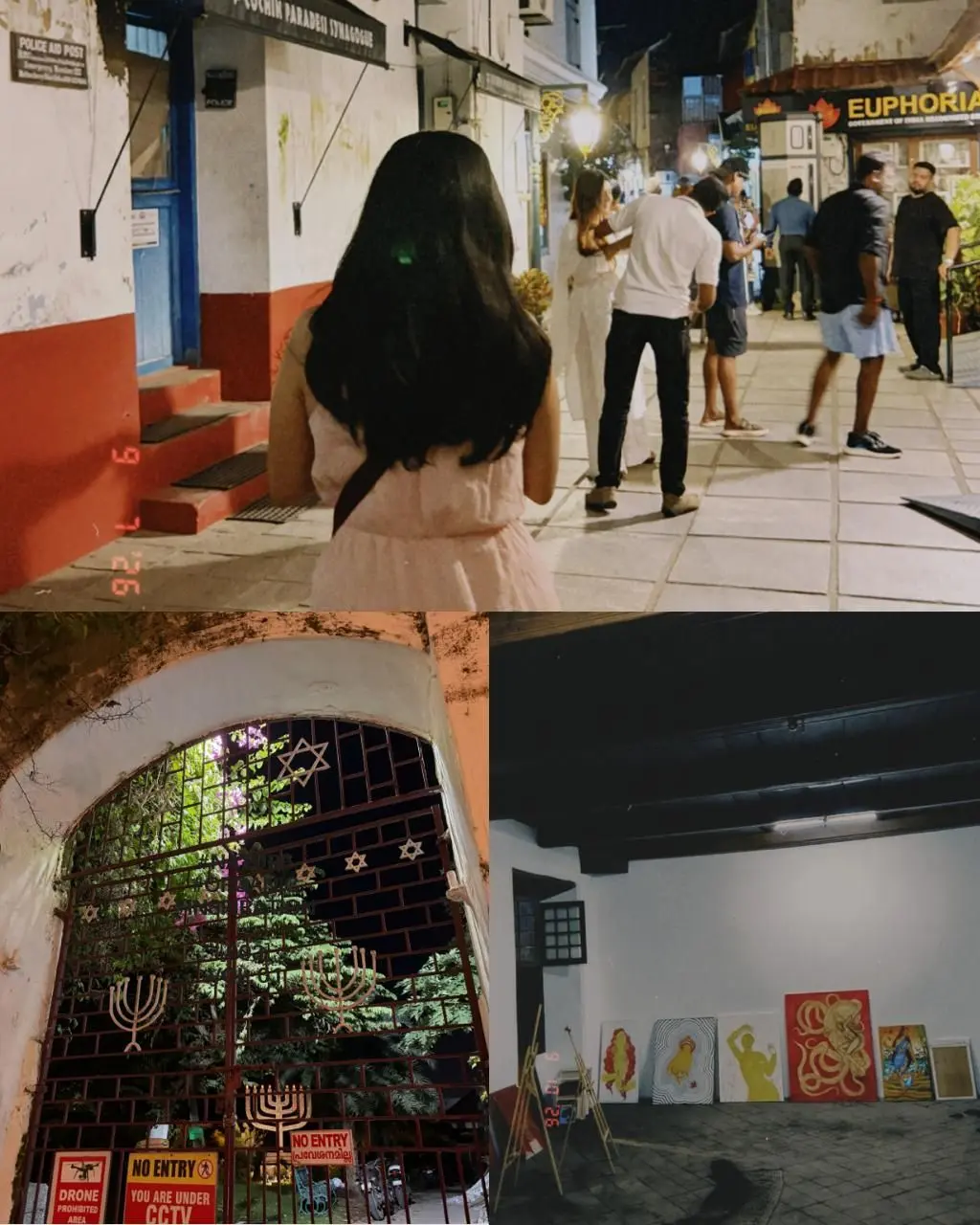
  • A woman with long dark hair in a light dress stands with her back to the camera on a paved street at night, looking toward a group of people gathered outside buildings with illuminated signs. Below, on the left, a metal gate with star and menorah decorations stands open behind a fence, with signs posted on it. On the right, inside a room with white walls and exposed ceiling beams, several framed artworks are displayed on easels against the wall.

    Friends of Thudippu: Edition 05

    Yes! Kerala has many art forms and traditions, and art is one of them. Many communities have practised and preserved these art forms for generations without expecting anything in return. These art forms reflect the history, culture and people of the land. The question for us was how to bring art forms like these into the mainstream. How can people come together with friends and engage with these art forms? How can we help them reach a wider audience and continue to thrive? This is when we started Friends of Thudippu (FOT). Since then, we have successfully hosted four editions at Thudippu Studio, Vennala. When we began planning the next edition, we wanted to try something different. “What if we take Friends of Thudippu (FOT) closer to a place that is deeply connected to Kerala’s cultural and historical landscape Fort Kochi and Mattancherry?” The whole team said yes! We started with a basic Google search and shortlisted a few spaces to see what might work. But Google was not our only source of information. We also reached out to friends and people around Kochi, and they suggested spaces and possibilities we had not come across ourselves. One of the spaces we came across was Artiko Tales, Mattancherry. It took us a while to explore the space because they had moved to this new location only about a month earlier. On the day we went to visit, we arrived a little early. Instead of going straight to the space, we walked through Jew Town. It was a beautiful, peaceful evening. The yellow lights were already on, and the streets were quieter. The character of that historic place felt different at that time of day. We decided to stop for a tea. Somehow, that chai time became an important part of the process. Sitting there and talking, we started thinking about what it would mean to bring the next Friends of Thudippu edition into this neighbourhood. It was not just about finding a venue anymore. The place itself started becoming part of the idea. When we arrived at Artiko Tales, we saw an artist painting in a room full of artworks, paintings and small sculptures. Some were finished. Others were still in the process of being made. She got up, smiled at us and said, “Hi, I'm Sudharshana.” She was the founder of Artiko Tales. We started talking about the space and our idea for Friends of Thudippu. Then she told us that she already knew about Thudippu. We did not expect that small connection to matter so much. At that point, the space felt less like something we had found. It felt more like something that had somehow come back to us at the right time. We were happy, excited and a little emotional about it. We decided to go ahead with Artiko Tales. And yes, the right space fits the audience and suits the experience.
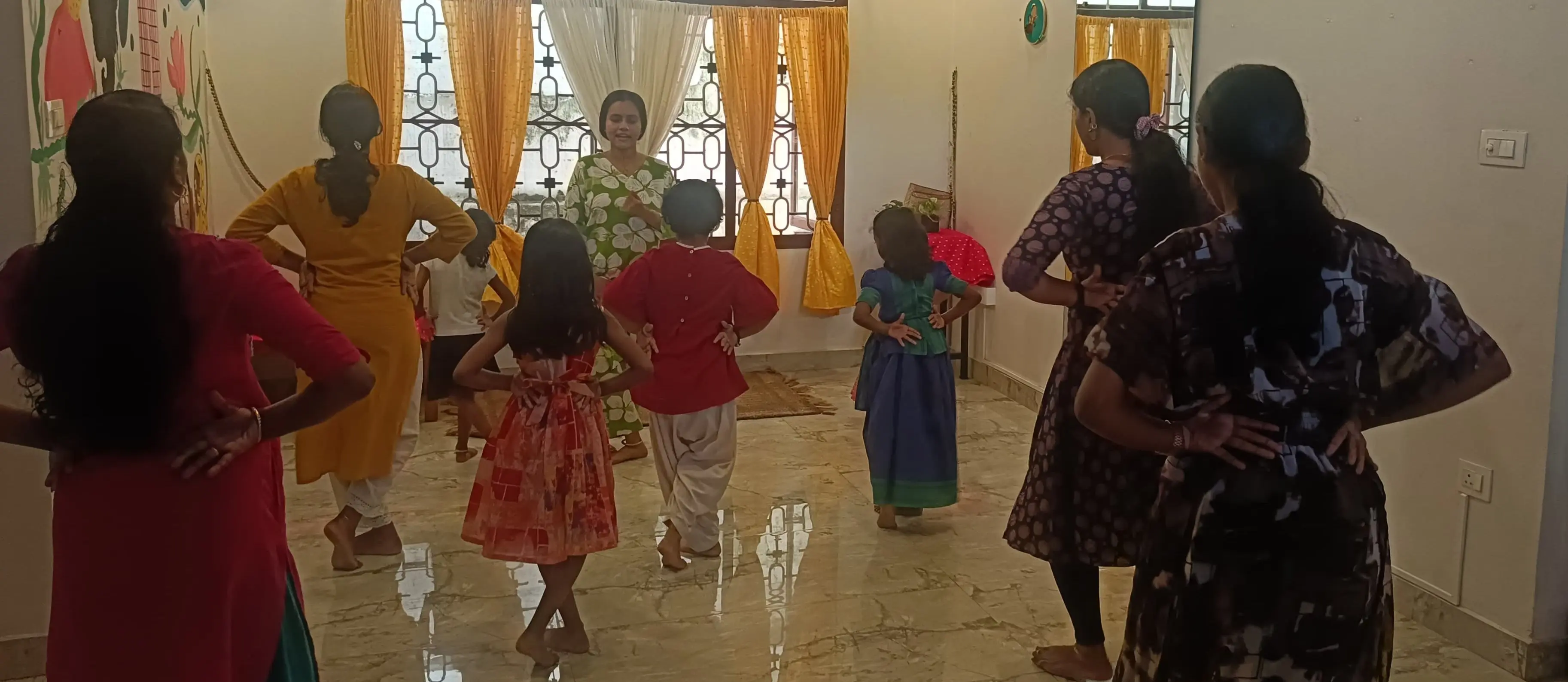
  • A group of people, mostly children and women, stand in a room with their backs to the camera, facing an adult woman who stands near a window with yellow curtains. The floor is shiny and reflective. One child wears a red top and light-colored pants, another wears a patterned dress, and a third wears a blue and green outfit. The women wear long dresses or tunics in various colors and patterns. A small child stands near the woman in the center. A chair with a red cloth is visible in the background.

    Dance students move into adavu and mudra practice

    Community dance classes are moving into a more technical stage. Students are practicing adavus and mudras. These are some of the more demanding parts of Bharatanatyam and Mohiniyattam. The sessions focus on posture, hand movements, and coordination. Students get the basics right through repeated practice.
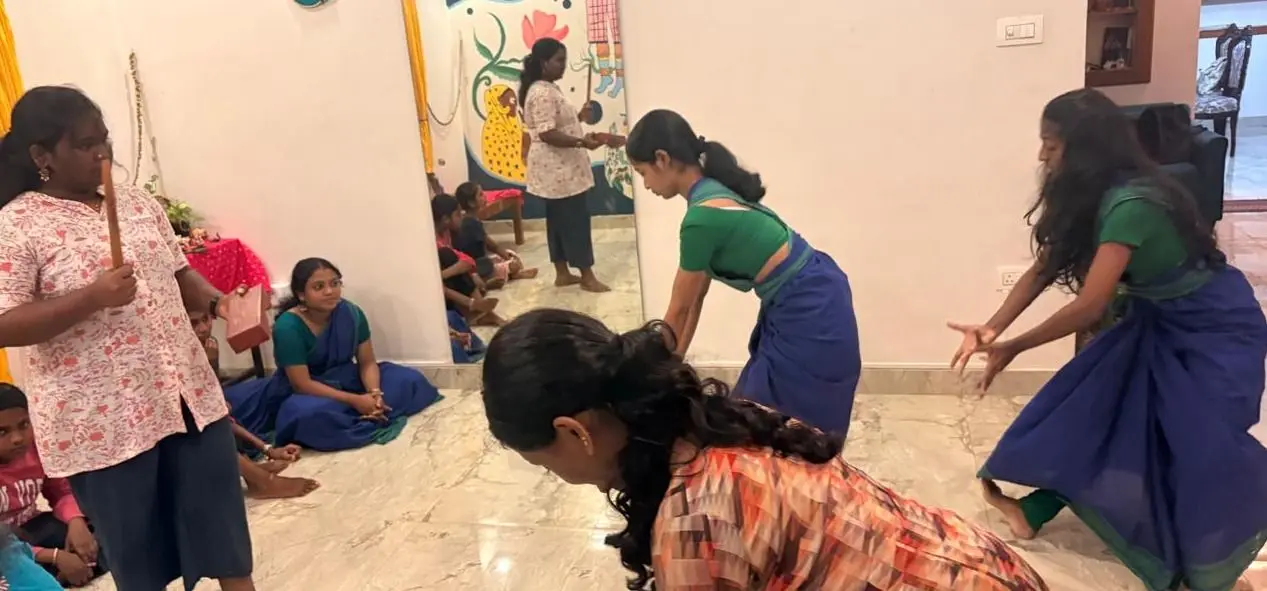
  • A group of women and children are gathered in a room with tiled floors and light-colored walls. Several women are wearing green tops and blue skirts, with some bending forward in a coordinated pose while others stand or sit nearby. One woman stands holding a long stick, and another sits cross-legged on the floor. A child sits on the floor near the left side. In the background, a doorway opens to another area where more people are seated, and a colorful painted wall is visible.

    Community dance classes move into abhinaya practice

    The Thudippu team ran the community dance classes. They split them into children's and adults' sessions. Aparna now works with both groups on more technical dance, including abhinaya, expression and communicating emotions through movement.
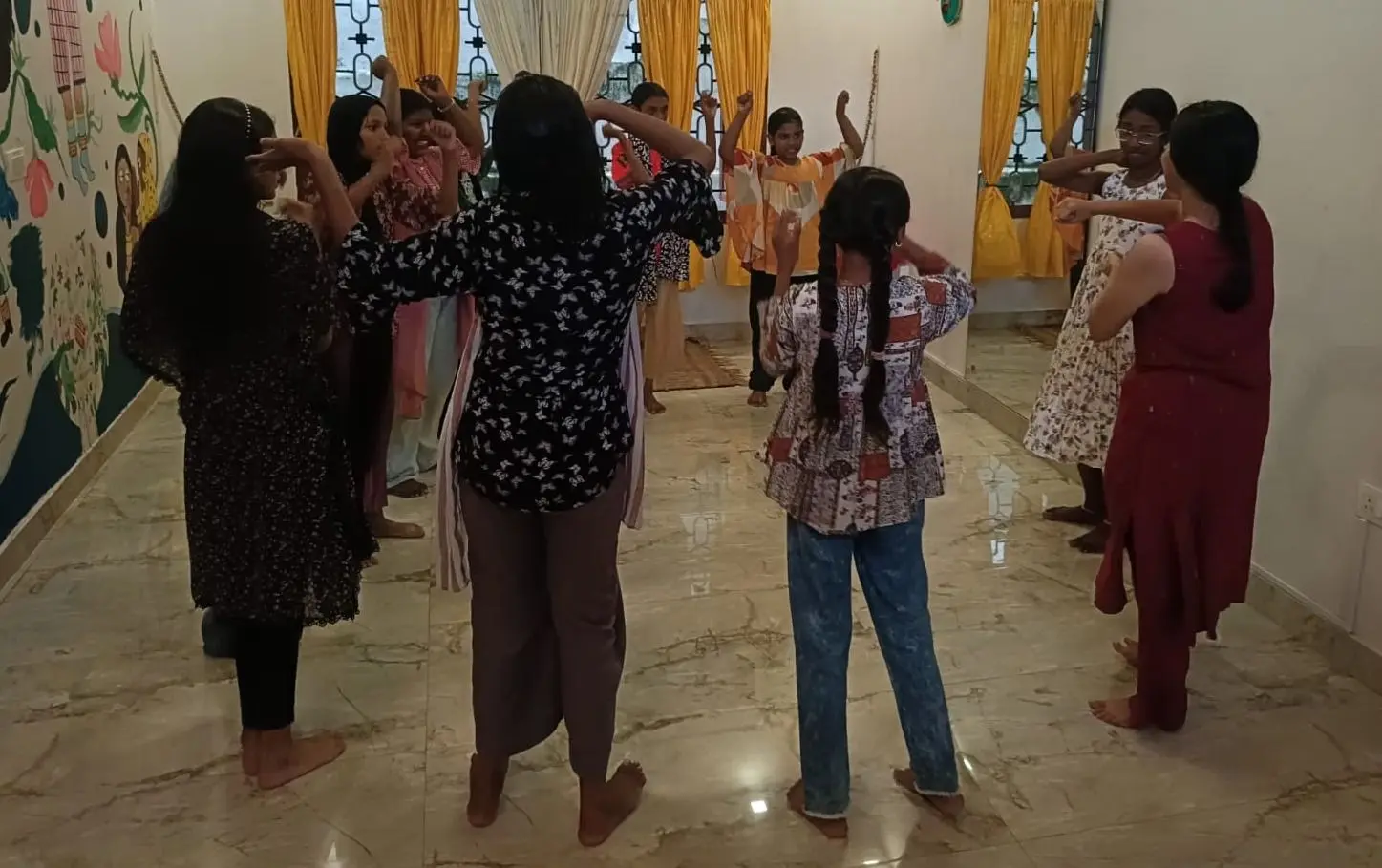
  • A group of people, including adults and children, stand in a circle indoors with their backs mostly to the camera, raising their arms above their heads as if dancing or exercising together. They are barefoot on a polished marble floor. Behind them are windows with yellow curtains and a wall decorated with a colorful mural.

    Community students practice for an upcoming program

    Community students met at aikyam space for dance practice. They were getting ready for an upcoming program. The sessions gave the group more time to learn together and support one another. They also built stronger connections through regular practice.
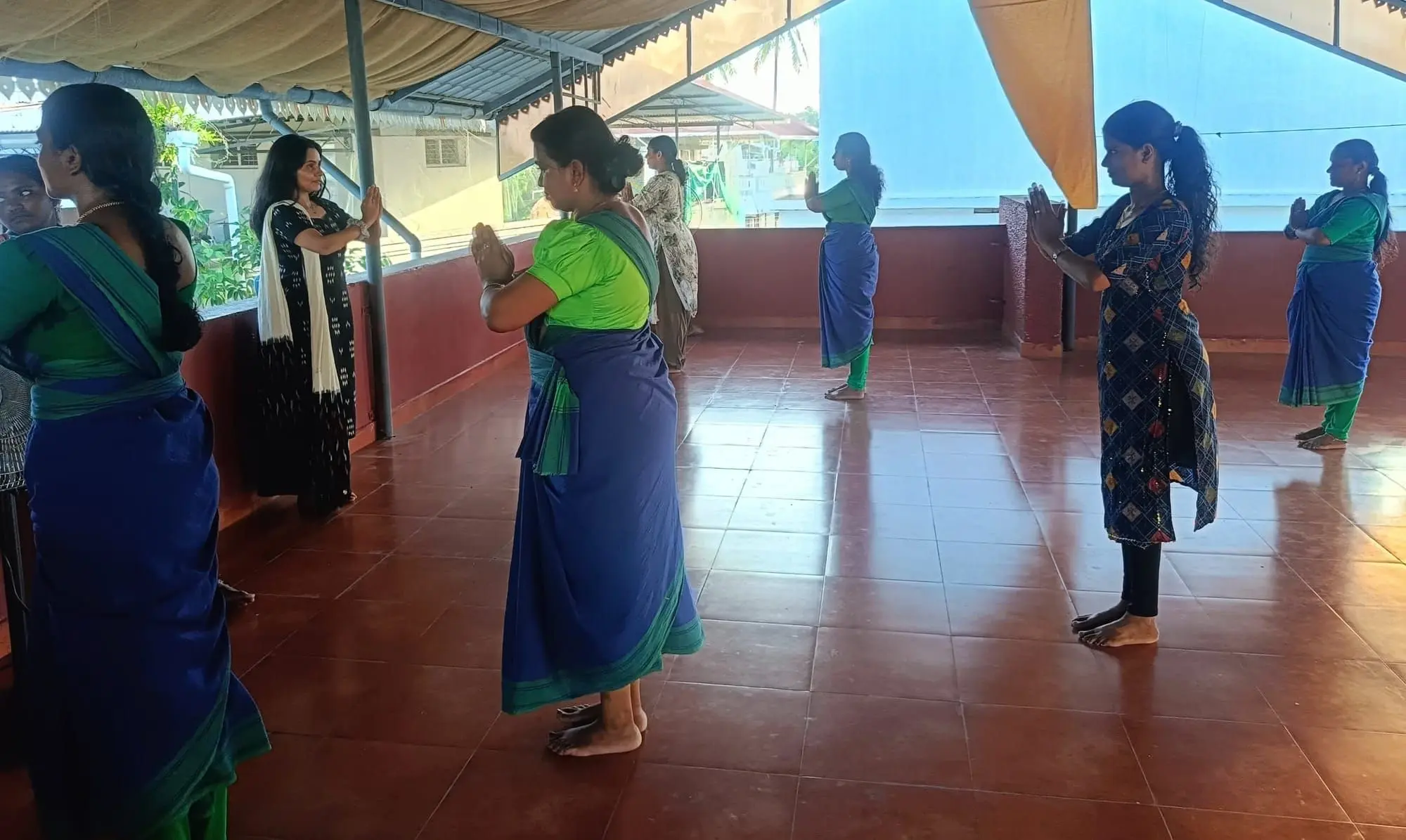
  • A group of women stand in a line on a tiled floor under a covered outdoor area, facing forward with their hands pressed together in a greeting gesture. They wear traditional clothing in various colors including blue, green, black, and white. The space has a reddish-brown floor and walls, with a light-colored roof overhead and open sides showing greenery outside.

    Dance class went on practising

    The community dance class went on with regular practice. The dancers got ready together. They felt more sure of themselves in every session.
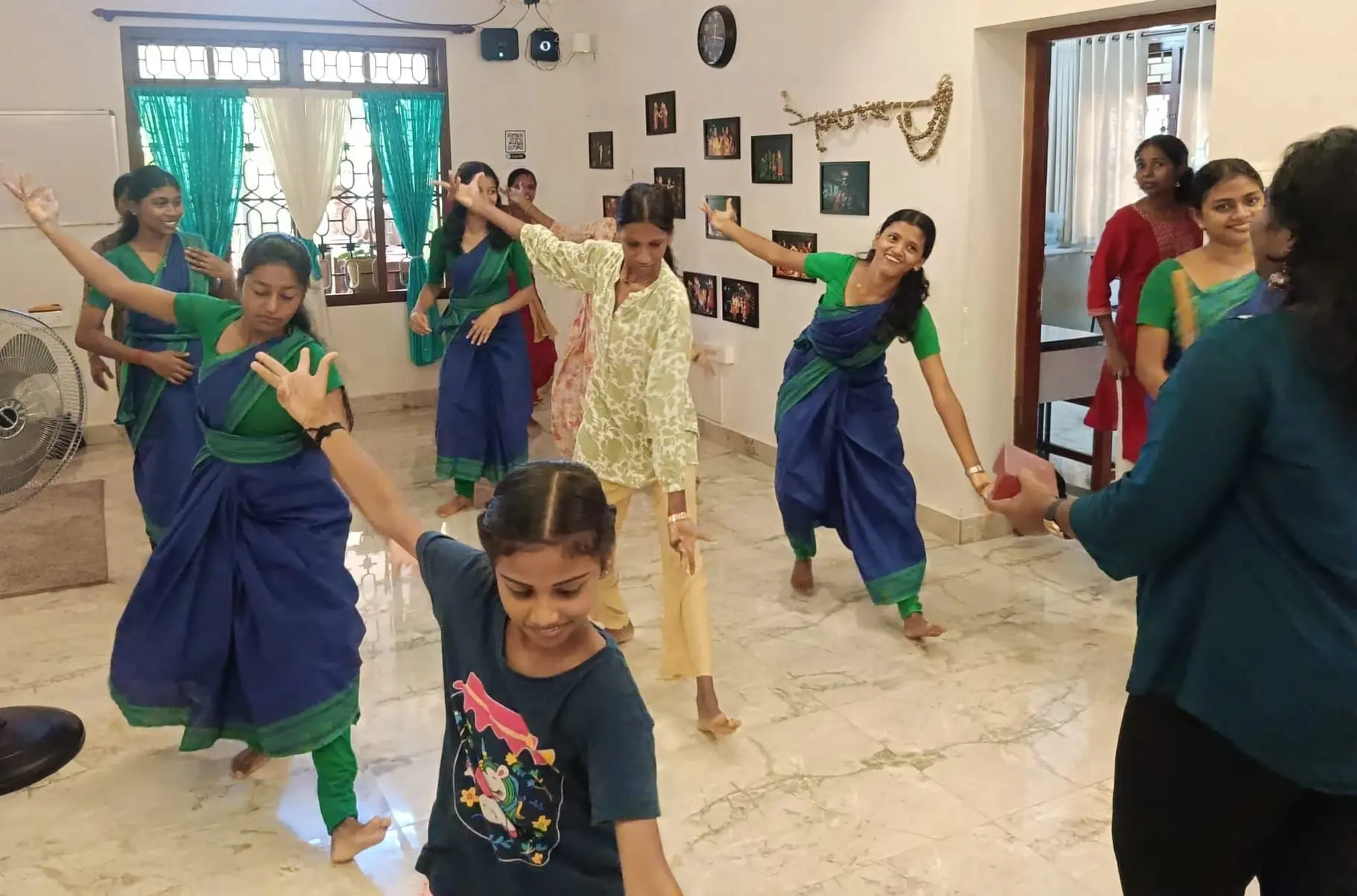
  • A group of people are dancing indoors on a tiled floor. In the foreground, a child in a dark blue t-shirt with a colorful graphic dances with arms raised. Behind them, several women and girls wear matching blue and green sarees or salwar kameez, moving in a circle with arms extended. One woman in a cream-colored patterned top and yellow pants dances in the center. Another woman in a teal top stands at the right edge, holding a small object. In the background, more people watch from a doorway and near a window with green curtains. A standing fan is visible on the left, and framed pictures hang on the wall.

    Rehearsals began for a performance in August

    Community members practised hard for the performance in August. We improved our confidence, co-ordination, and stage presence. We prepared together through regular rehearsals.
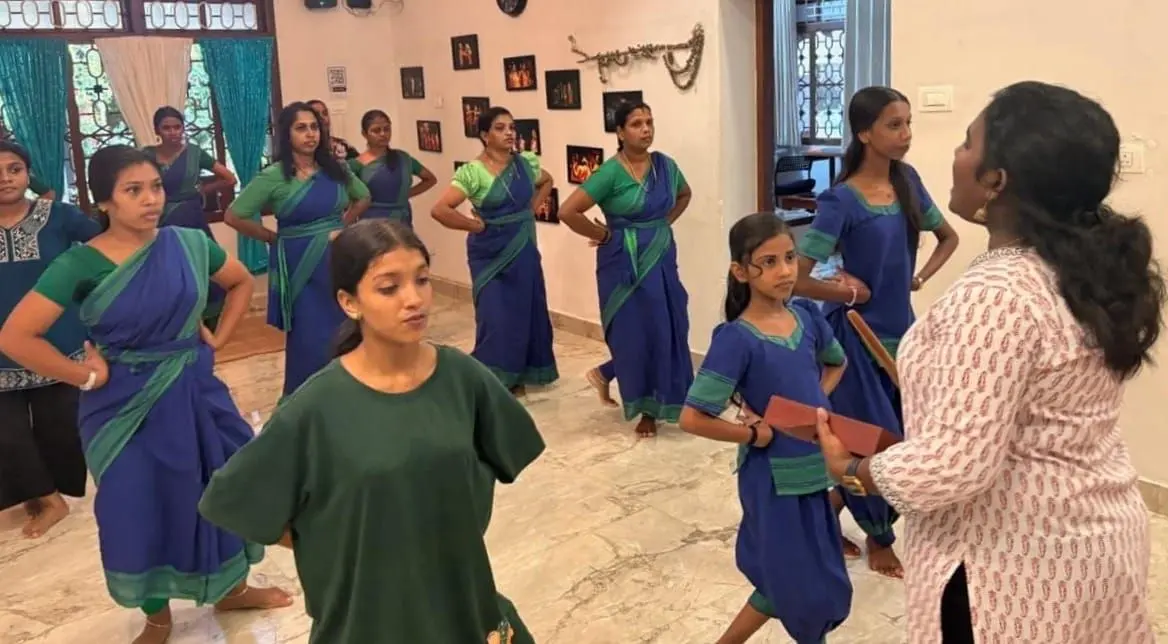
  • A group of women and girls stand in a room wearing matching blue and green outfits, with one woman in a patterned pink top facing them and holding a book.

    Thudippu students practised for their first stage show

    Thudippu Dance Foundation spent the day practising with students for their first official stage show. We focused on improving co-ordination and confidence. We also worked on getting ready for the stage. It was exciting to see the students preparing together for this important milestone.
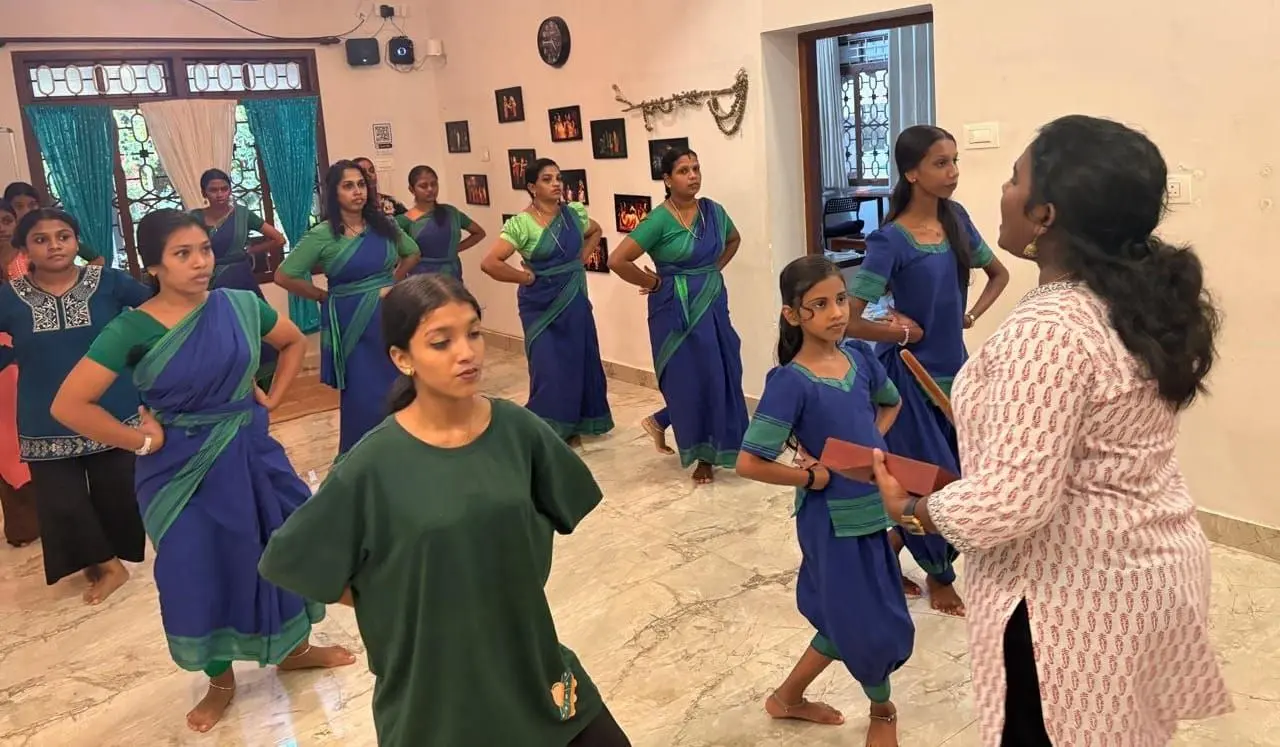
  • A group of girls and women in matching blue and green sarees stand barefoot in a room, facing a woman in a patterned top who holds a book and appears to be instructing them. One girl in the foreground wears a green top instead of a saree. The room has tiled floors, framed pictures on the wall, and a window with blue curtains.

    The community dance class practised together again

    The community dance class continued. Dancers practised together again. They grew in confidence through regular learning and working as a team.
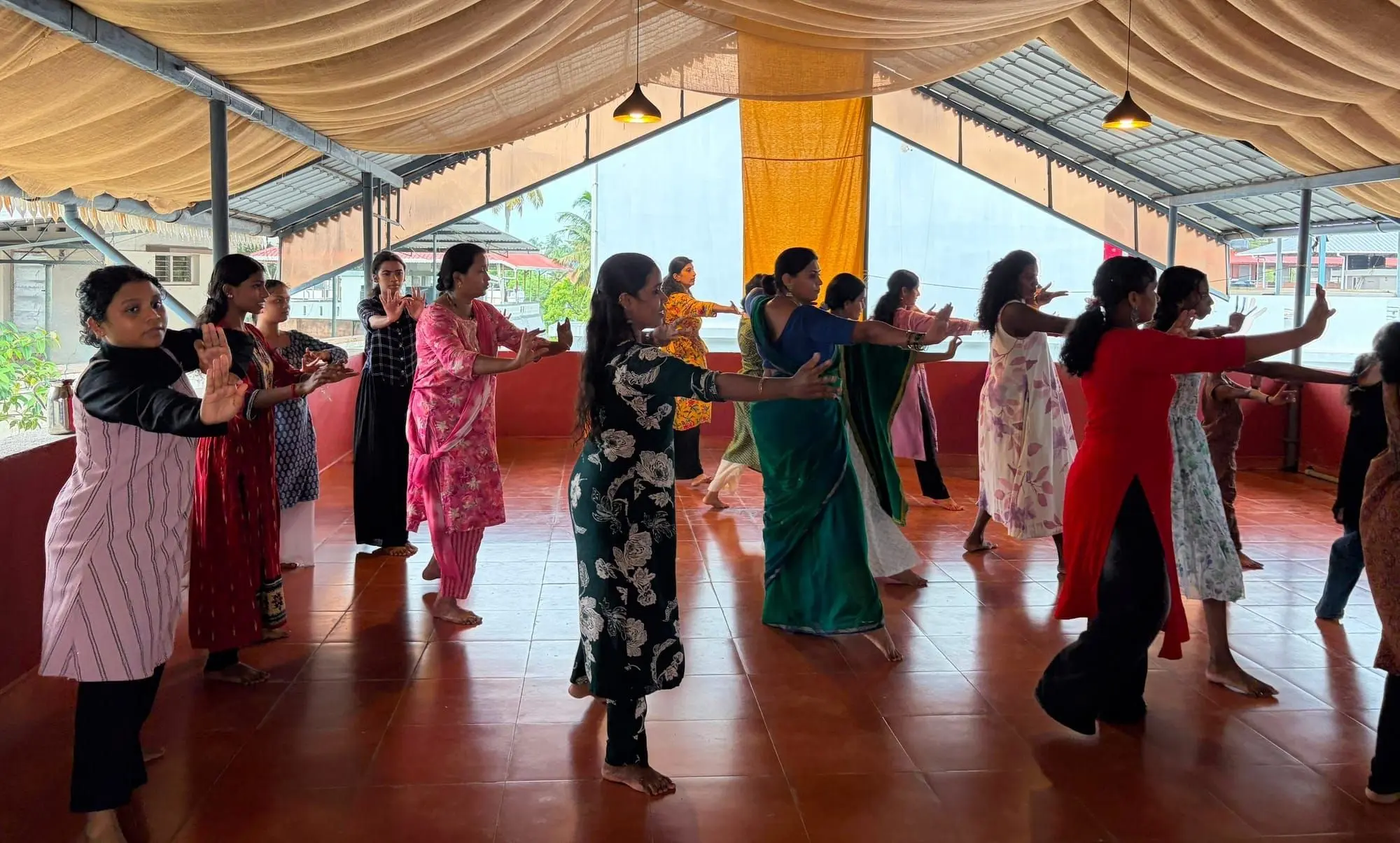
  • A group of women stand in a line inside a covered hall with a tiled floor and draped fabric ceiling, performing synchronized hand movements while wearing traditional Indian clothing in various colors and patterns.

    Students grew steadier with every dance practice

    Students kept up their regular dance practice. Every session built their confidence. It built their co-ordination too. Their expressions grew with each session.
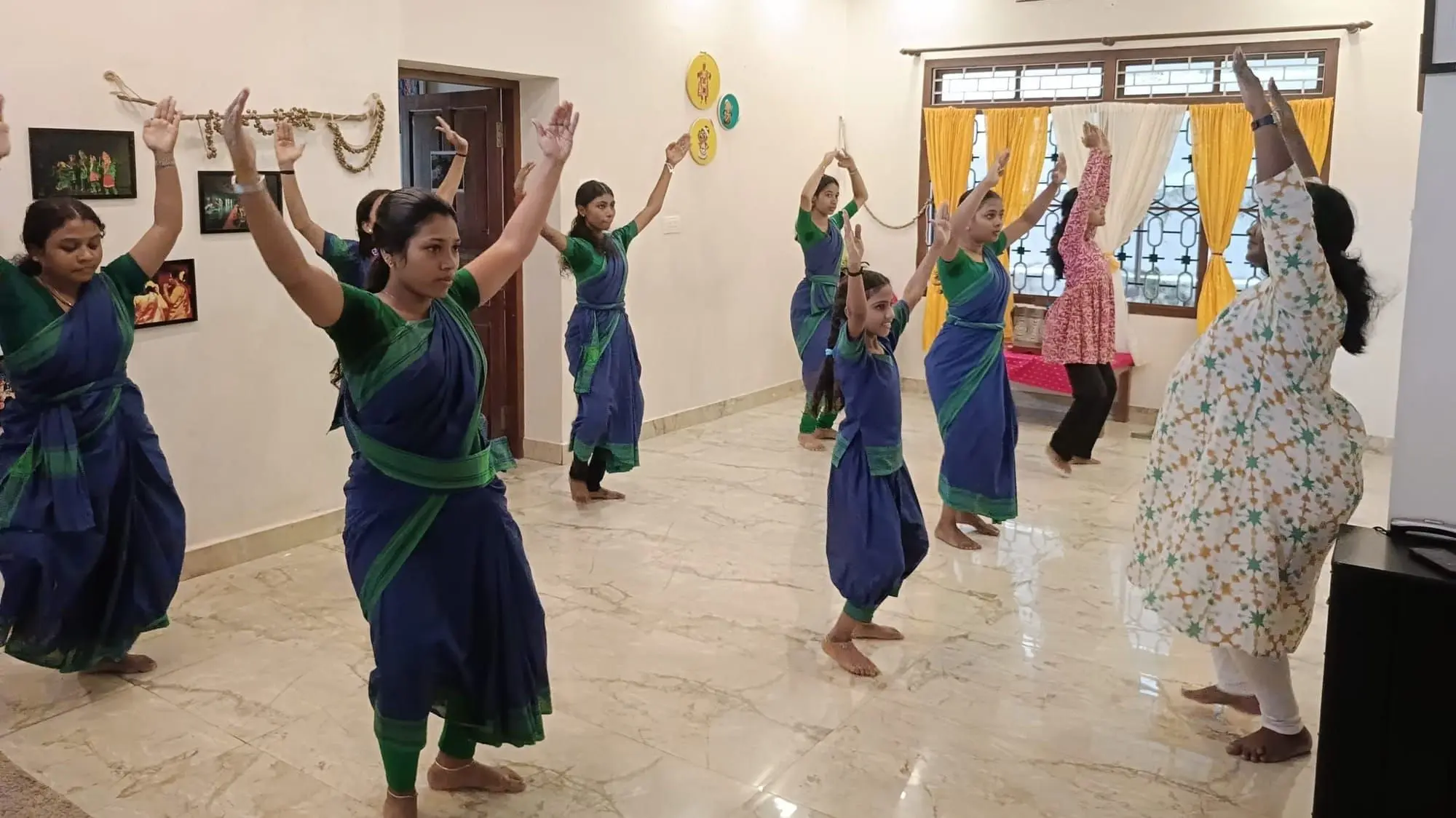
  • A group of people are dancing indoors in a room with light-colored tiled floors and white walls. Most are wearing blue and green sarees, while one person wears a patterned white tunic and another wears a pink patterned top with black pants. They are barefoot and have their arms raised in various poses. Framed pictures hang on the wall, and a doorway is visible in the background. A window with yellow curtains and decorative grilles lets in light, and a small red bench sits near the window.

    Dance class for the community met to practise

    The dance class for the community met to practise together. It brought participants together to practise, learn, and build confidence through dance.
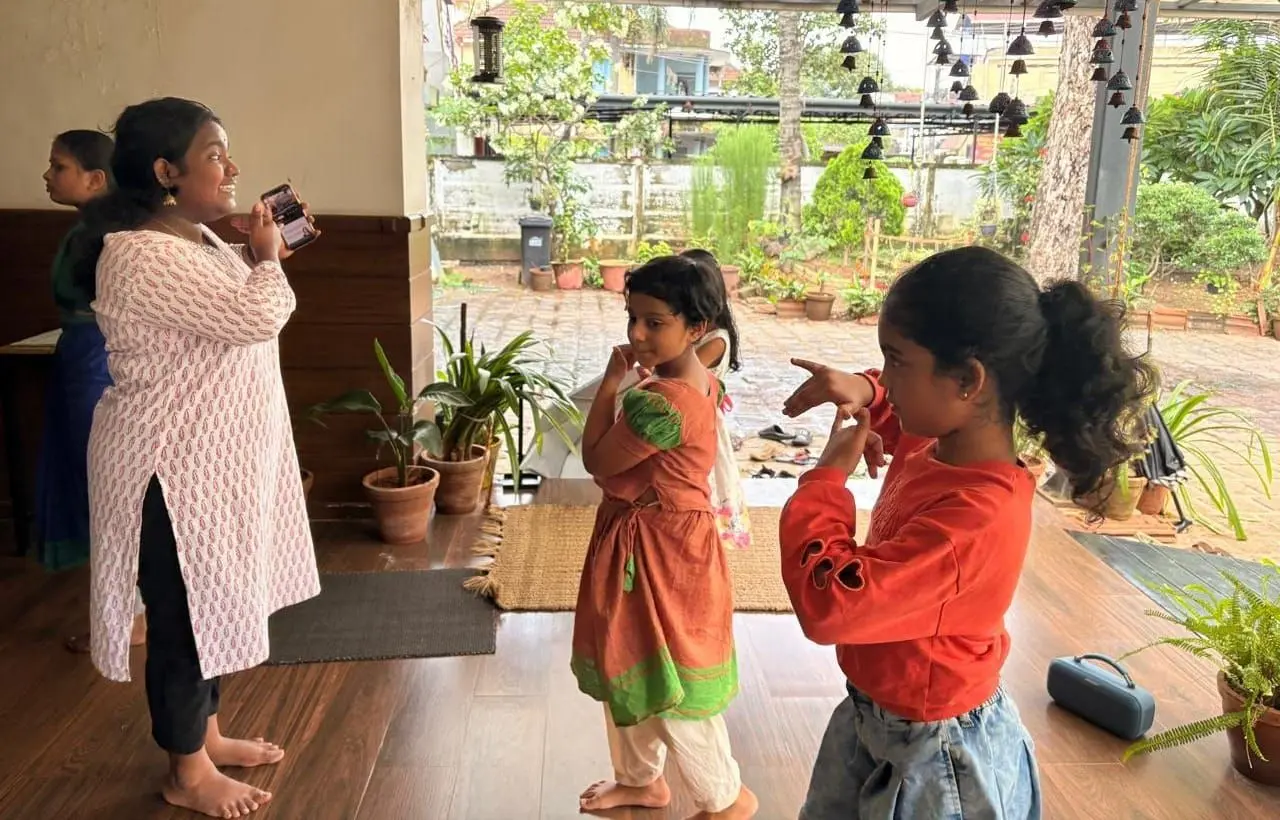
  • A woman stands barefoot on a wooden floor holding a phone, facing three young girls who are also barefoot and appear to be dancing or playing together indoors near an open doorway that leads to a garden area with potted plants and hanging decorations.

    Thudippu ran a semi-classical dance workshop for all levels

    Thudippu ran a dance workshop. It was semi-classical. People of all levels came. We gave them room to explore movement, music and self-expression. They learned together.
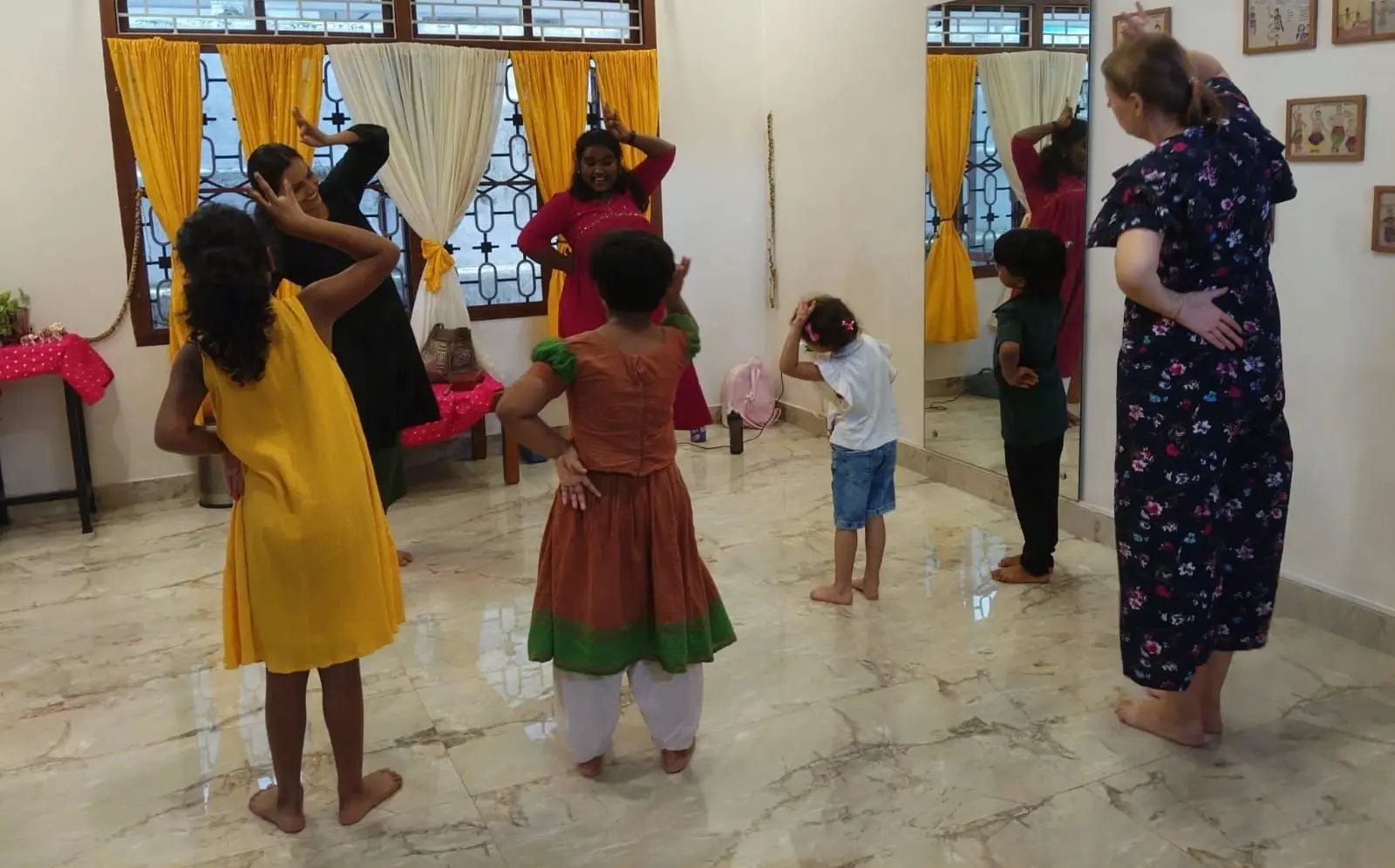
  • A group of children and adults stand barefoot in a room with tiled floors, facing a large mirror and copying movements with their hands raised. Yellow and cream curtains hang over windows behind them, and a woman in a dark patterned dress stands to the right observing.

    Kids' dance class worked on new steps

    The regular kids' dance class continued on Tuesday, Nov. 14, 2023. Students practised new steps, expressions, and co-ordination. Regular practice helped them become more confident in a fun and encouraging environment.
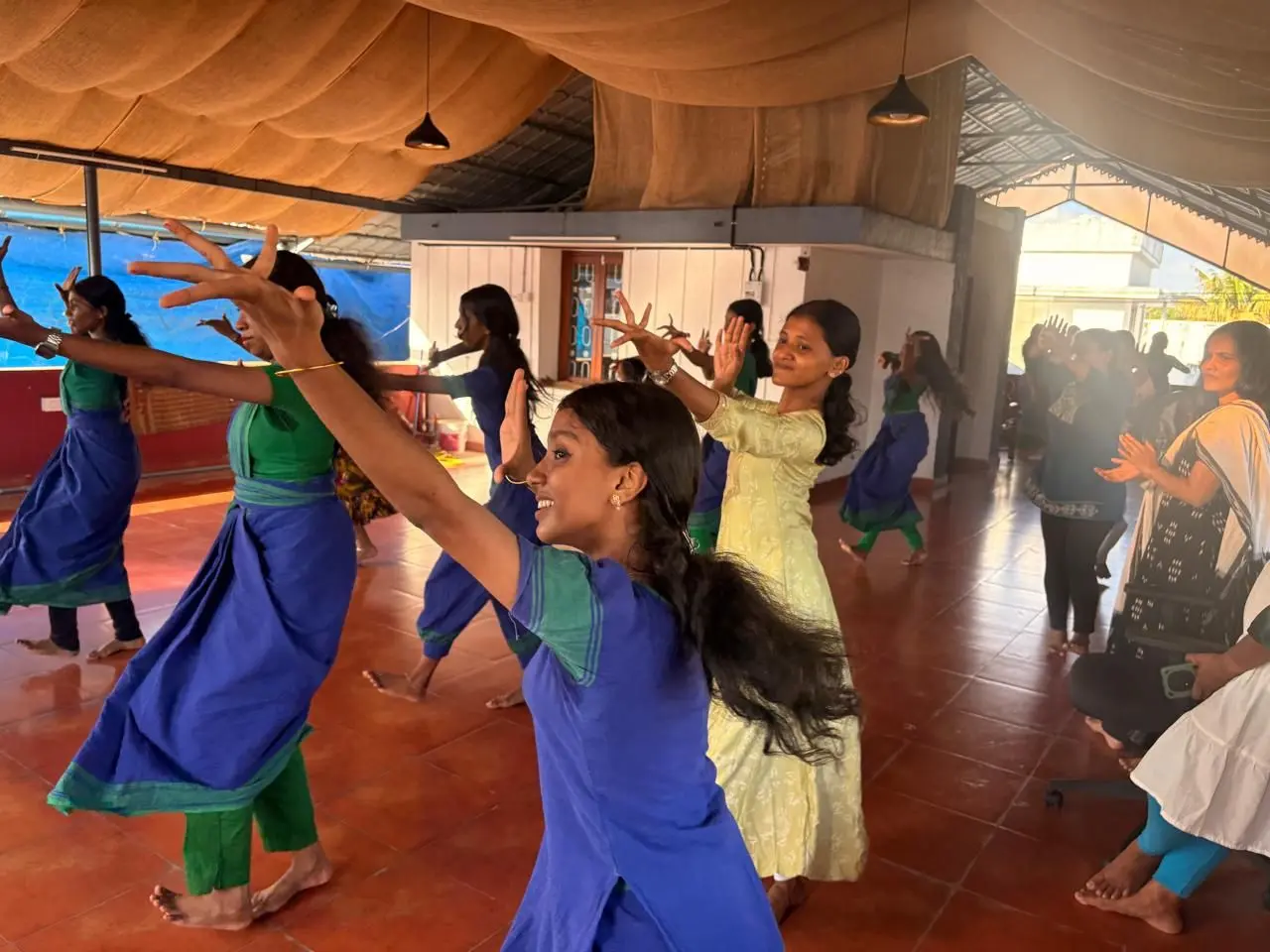
  • A group of young girls perform a dance indoors on a tiled floor, wearing blue and green outfits and one in a yellow dress, with their arms raised in coordinated poses. Other people stand and sit around the edges of the room watching, some clapping. The space has a draped fabric ceiling and hanging lights, with an open doorway letting in daylight.

    The dance club practiced movement and teamwork

    The dance club kept up its regular practice. Members built confidence, co-ordination and teamwork through movement.
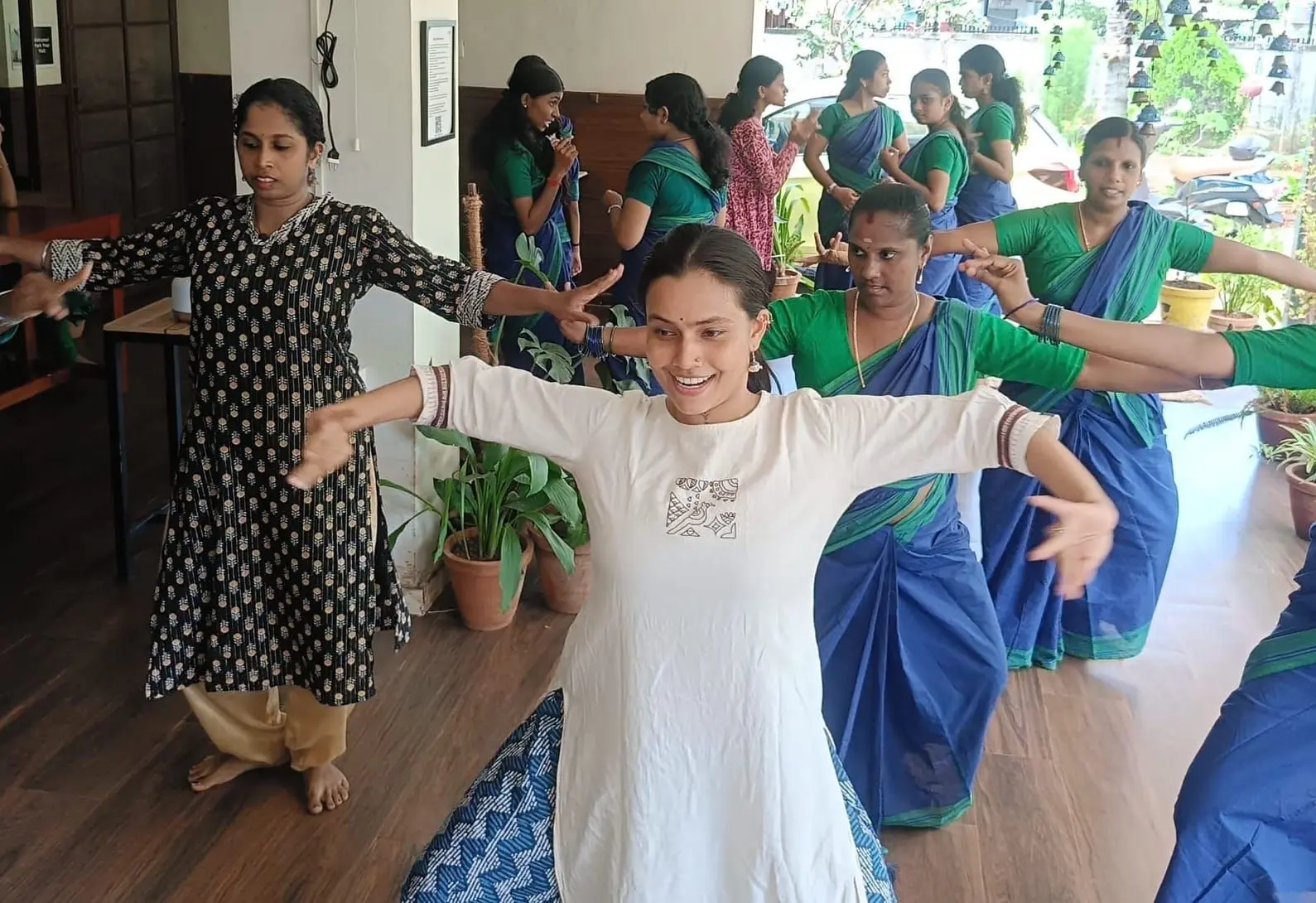
  • A group of women are arranged in a line indoors, performing a synchronized movement with their arms extended forward and hands open. The woman at the front wears a white tunic with a patterned panel on the chest and a blue patterned skirt, smiling as she looks toward the viewer. Behind her, other women wear green tops with blue or green sarees, while one woman to the left wears a black patterned tunic with light-colored pants. Several potted plants are visible on the floor, and the setting appears to be a room with wooden flooring and a doorway leading outside.

    Steps, rhythm and expressions practised again

    The regular dance class continued with students practising steps, rhythm, and expressions. Going to every class helped them become more confident and comfortable with each session.
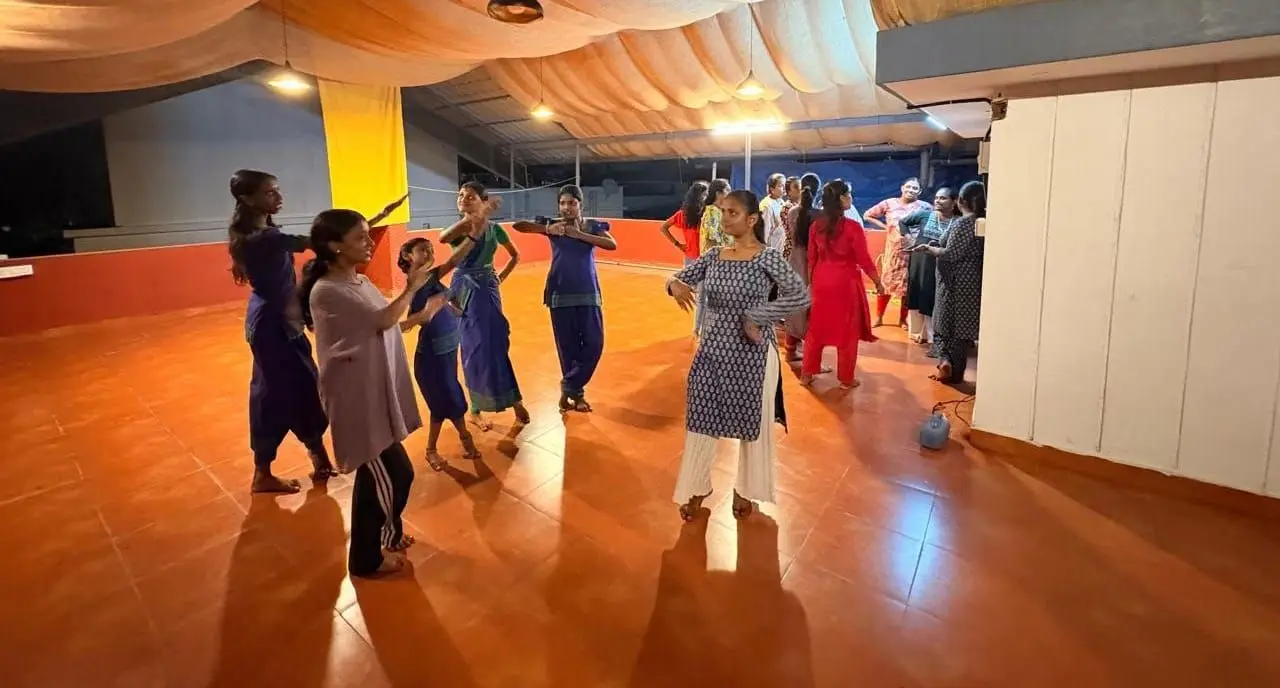
  • A group of people are gathered in a large indoor hall with a polished orange floor and draped fabric on the ceiling. In the foreground, several individuals are standing in a line, performing coordinated hand gestures and poses as if dancing or rehearsing a routine. One person in a patterned tunic and white trousers stands slightly apart, facing the group with hands on hips. Behind them, more people stand in a loose cluster near a white paneled wall, some watching and others participating. The lighting comes from overhead fixtures, casting long shadows across the floor. A bright yellow panel hangs on the left wall, and a small blue object rests on the floor near the right wall.

    Dancers learned from each other in the group class

    Dancers learned from each other in the group class. The community dance class brought people together to learn, practice and enjoy dance as a group. Regular sessions helped participants build confidence while learning from and supporting one another.
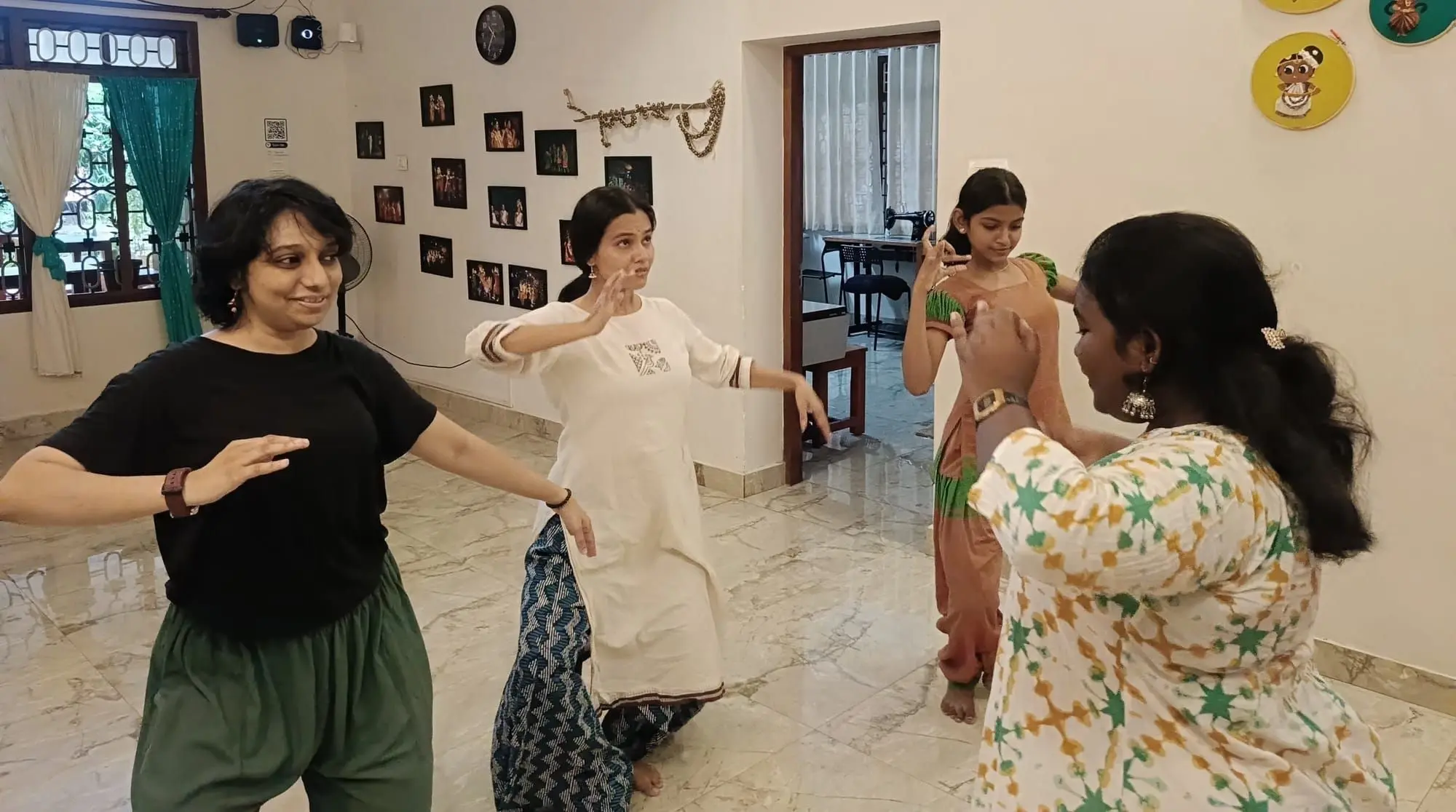
  • Four women stand in a room with tiled floors and white walls, performing synchronized hand gestures and body movements. One woman wears a black top and green trousers, another wears a white tunic over patterned trousers, a third wears a peach-colored outfit with green accents, and the fourth wears a white top with green and orange star patterns. The walls feature framed photographs, decorative wall hangings, and circular wall art. A doorway in the background leads to another room with furniture visible through it.

    The dance class worked on new movements and expressions

    The regular dance class continued. Dancers practised new movements, expressions and co-ordination. They grew more confident and more comfortable with each session. They made steady progress in their learning journey.
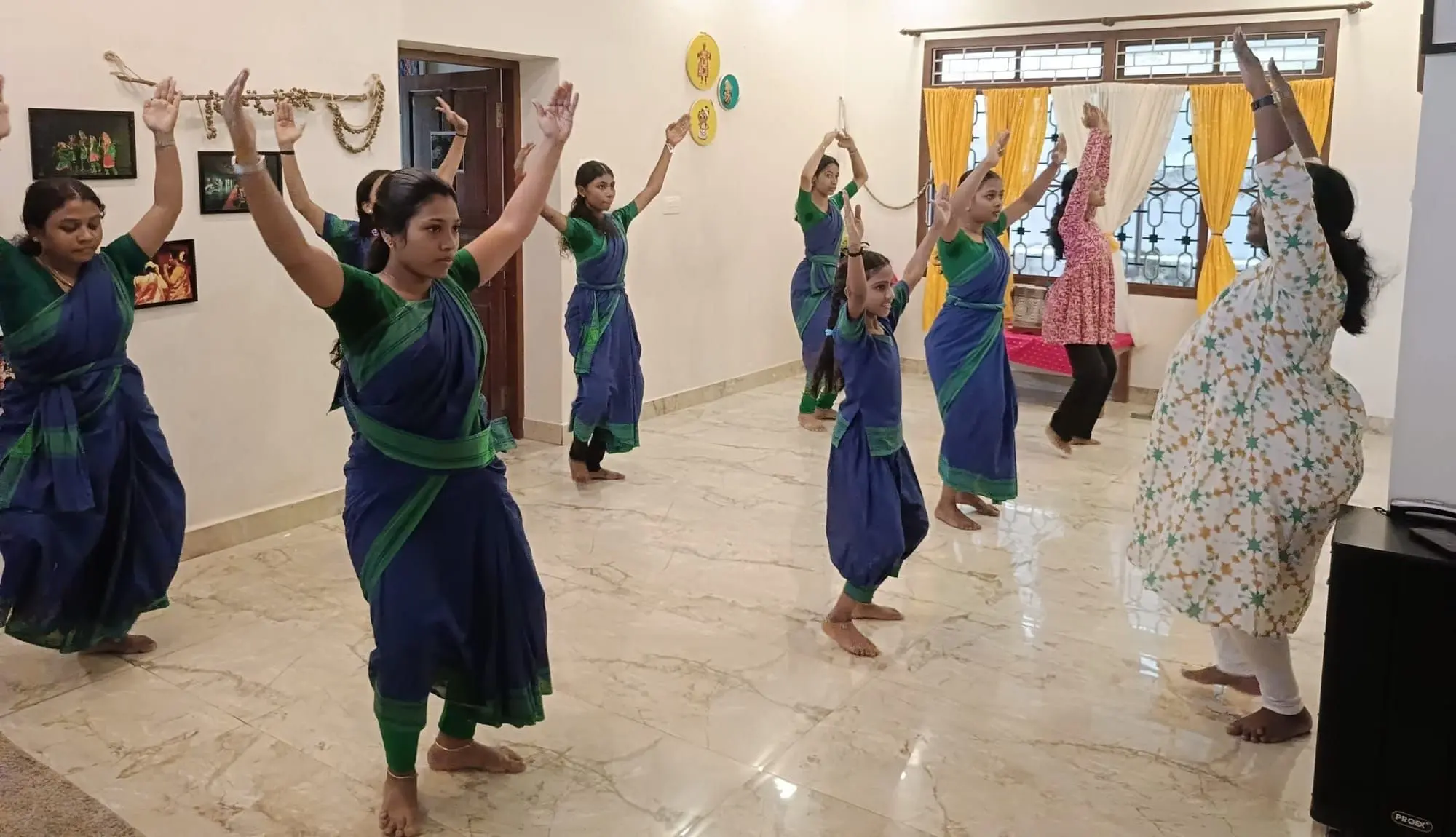
  • A group of people are dancing indoors on a polished floor, most wearing blue and green sarees or matching outfits with their arms raised. One person in a patterned dress stands to the right, also with arms raised. Framed pictures hang on the wall, and a doorway and window with yellow curtains are visible in the background.

    Dancers from different backgrounds practised together

    The community dance class took place on March 14, 2024. People from different backgrounds learned and practised dance together. As their confidence grew, many felt more at ease with the movements, expressions and group work.
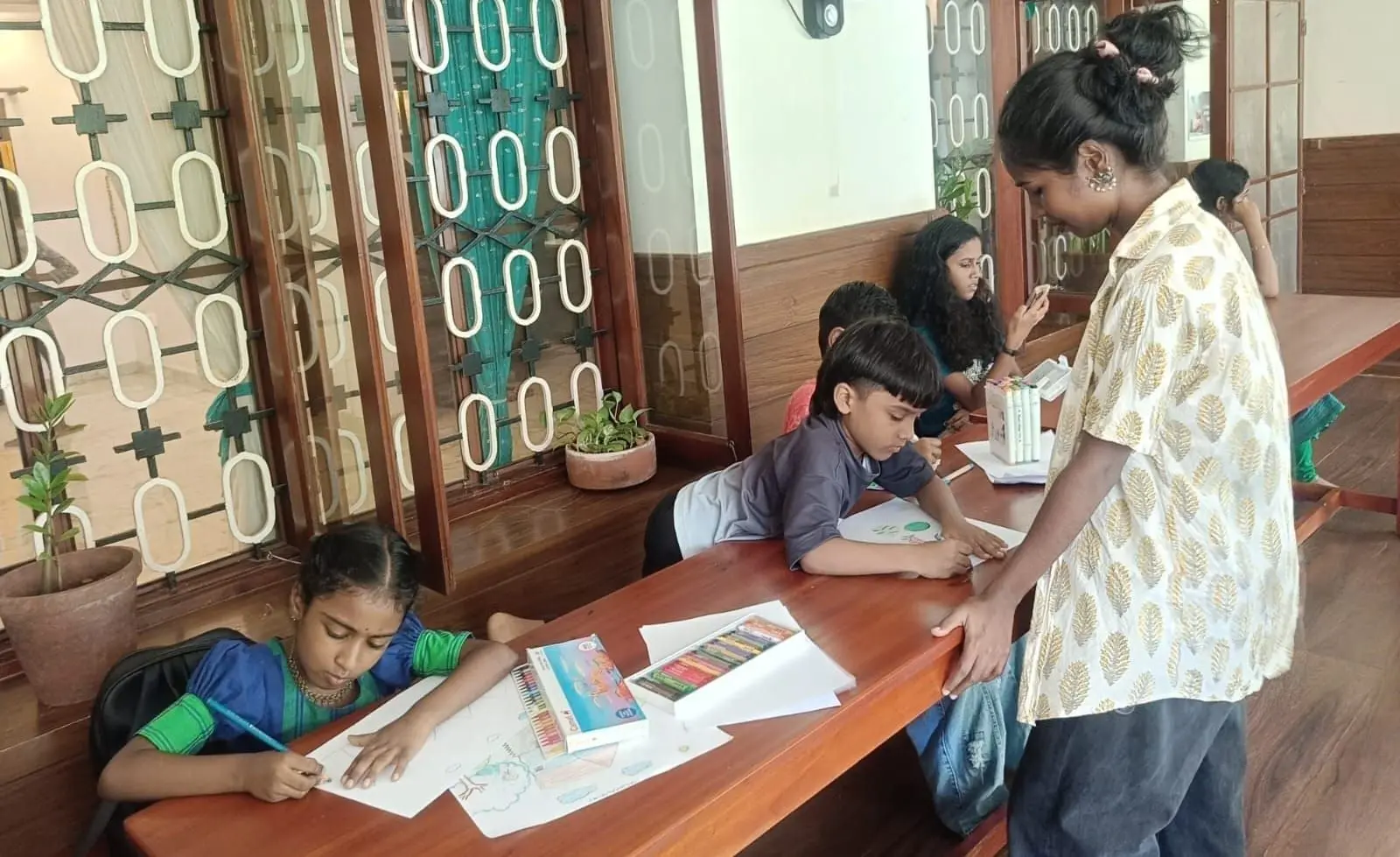
  • A woman stands beside a long wooden table where several children are seated and drawing on paper. One child in the foreground writes on a sheet with a blue pen, while another child to the right draws with a green pen. Open books and loose papers are spread across the table. Behind them, a woman with long dark hair sits at the same table, looking toward the standing woman. To the left, potted plants sit on a wooden bench beneath a window with a decorative grid pattern. Another person is partially visible in the background on the right.

    The children keep building skills and discipline

    The children keep building their skills and discipline through regular practice.
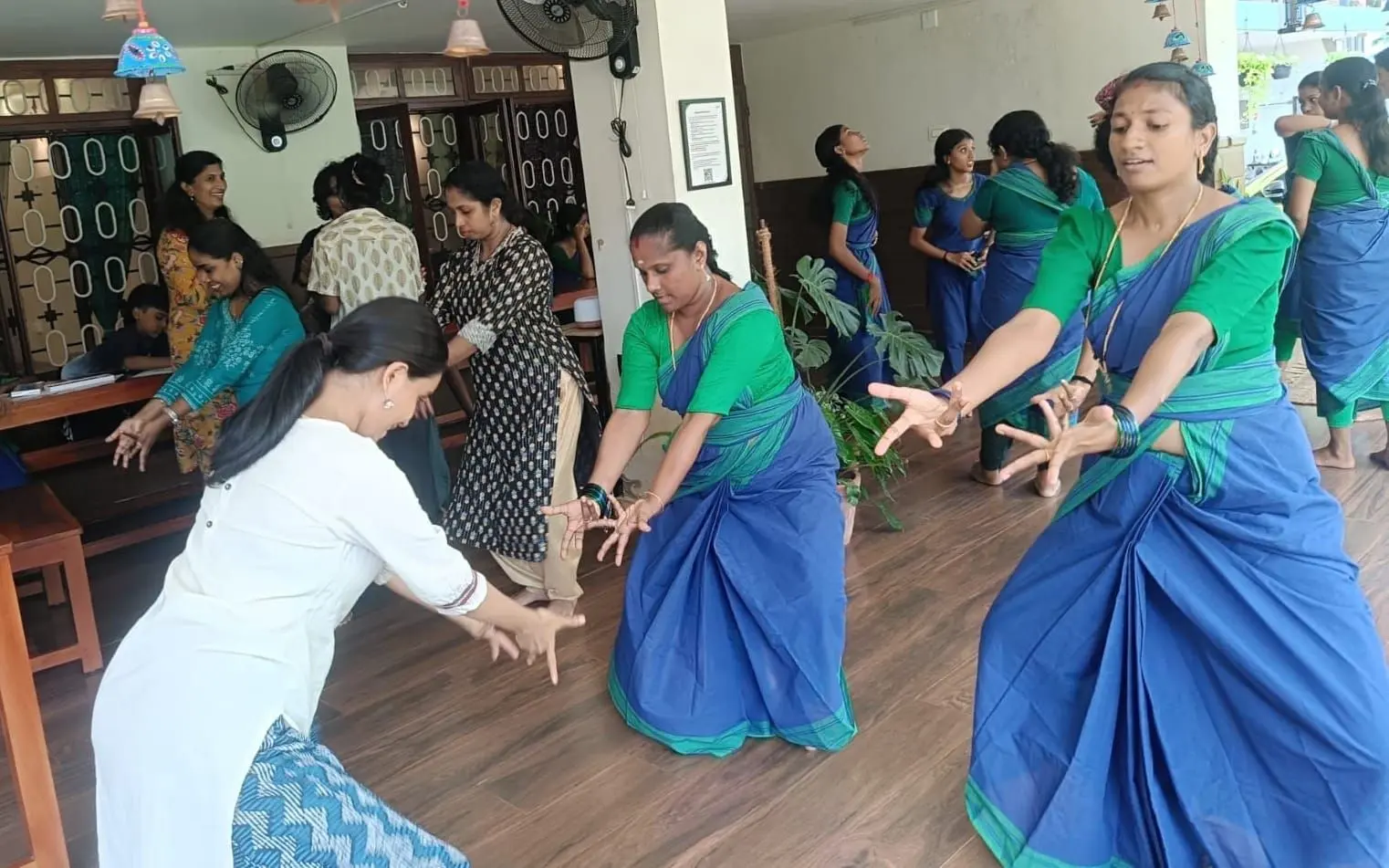
  • A group of women in blue and green sarees perform synchronized hand gestures in a room with wooden flooring, while a woman in a white top and patterned skirt mirrors their movements in the foreground. Other women stand in the background observing, and a few people are seated at tables along the left wall. A potted plant stands near the center, and ceiling fans and hanging lamps are visible above.

    New steps learned at the community dance class

    The community dance class went on with enthusiasm. Dancers learned new steps. They practised together.
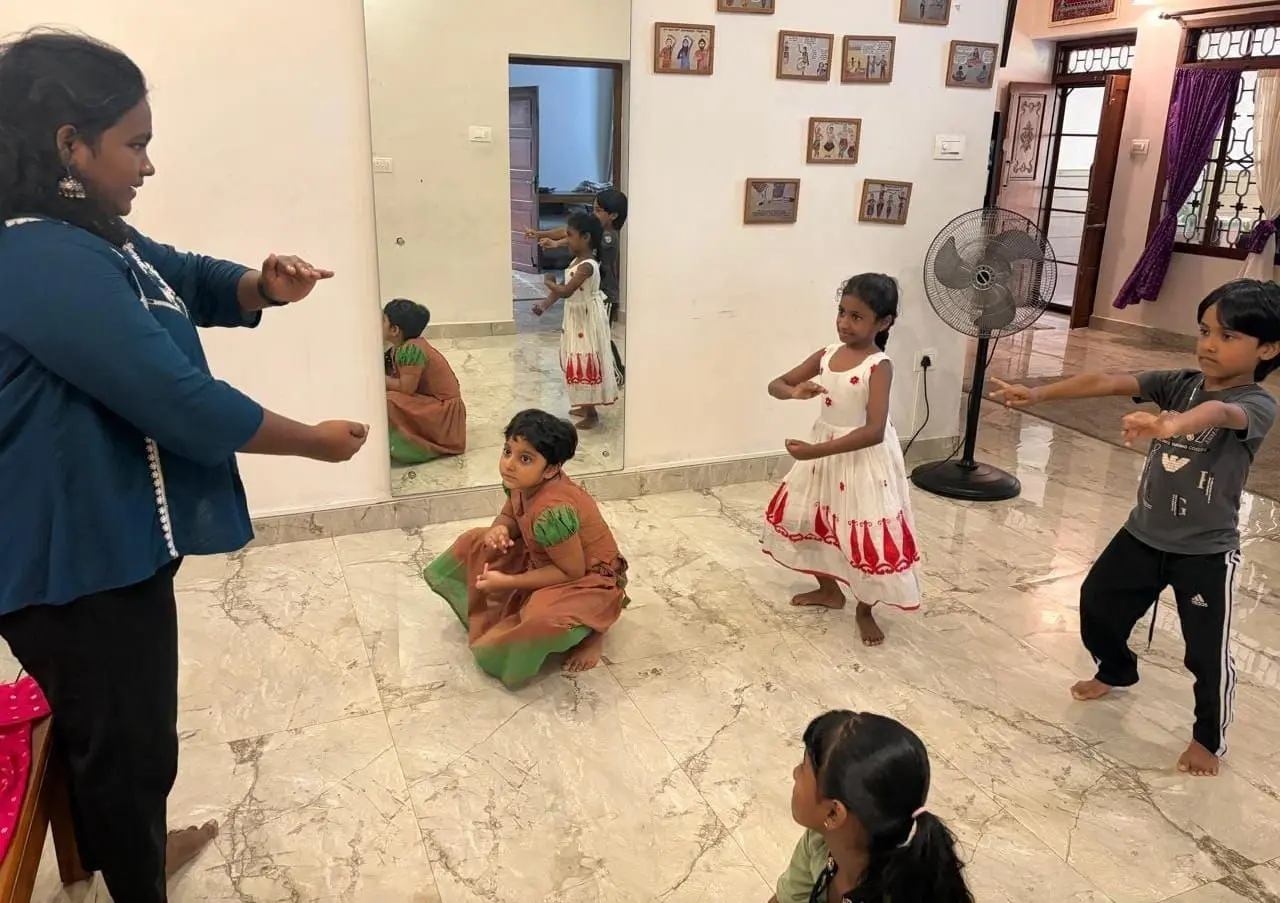
  • A woman in a blue top stands with her arms extended, guiding a group of children in a room with tiled floors. Several children are dressed in traditional-style outfits, including a girl in a white dress with red patterns and another in a brown and green outfit sitting on the floor. One child stands with arms outstretched, while another sits in the foreground watching. A large mirror on the wall reflects the scene, showing additional children and a doorway leading to another room. A standing fan is positioned near the wall, which is decorated with multiple framed pictures. A doorway with purple curtains is visible in the background.

    The children dance with more confidence than when they started

    The children continued to make good progress in their dance classes. They were more confident, coordinated, and comfortable performing different steps than when they started. Regular practice helped them grow in both skill and confidence.
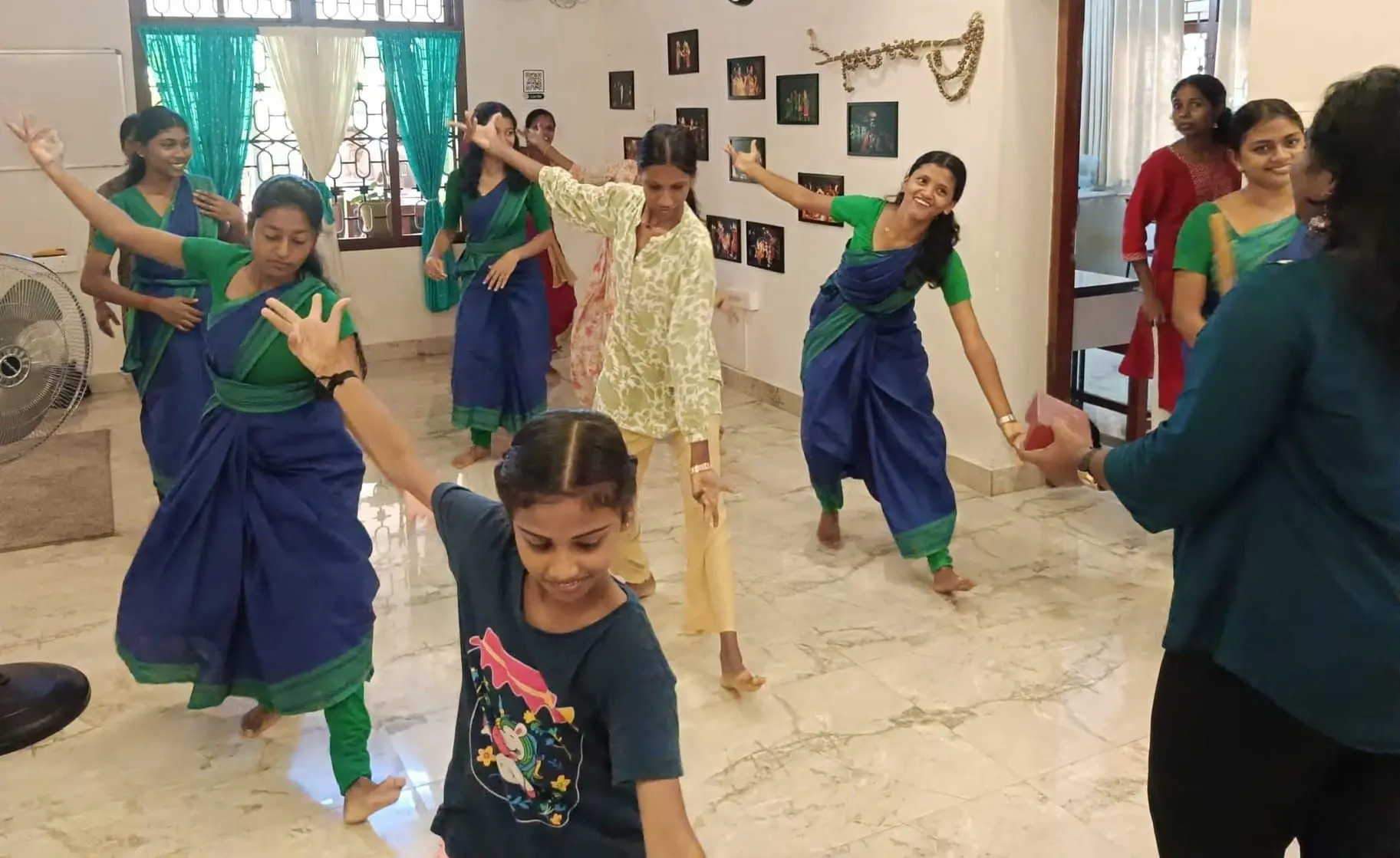
  • A group of people are dancing indoors on a tiled floor, with several women and girls wearing blue and green sarees and one girl in the foreground wearing a dark blue t-shirt with a graphic print. A woman in a light-colored patterned top and yellow pants dances in the center, while others move with raised arms around her. A standing fan is visible on the left side of the room, and framed pictures hang on the wall behind the dancers. A doorway on the right leads to another area where more people are standing and watching.

    The adult batch started coming in dance uniforms

    The adult dance batch started attending classes in their dance uniforms on March 14, 2024. We moved them to the next level of training. This shows their dedication.
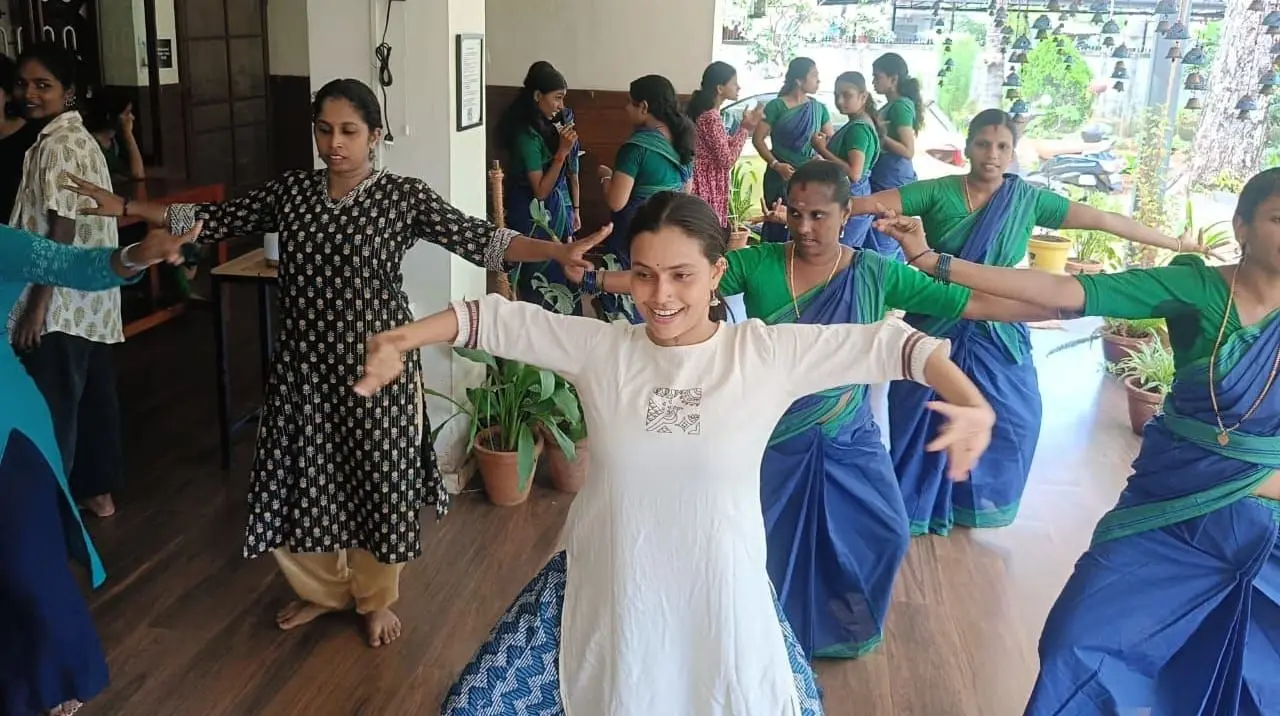
  • A group of women are gathered indoors on a wooden floor, performing a synchronized movement with their arms extended outward. In the foreground, a woman in a white top smiles at the camera with her arms spread wide. Behind her, several women wear matching green tops and blue sarees, arranged in a line with their arms also extended. To the left, another woman wears a dark patterned tunic with light-colored pants. Potted plants are visible near the wall, and more people stand in the background near a doorway and windows that look out onto greenery.

    Another dance session spent on movement and expression

    Students gathered for another dance session on March 14, 2024. We spent time refining movements, rhythm and expressions. Through regular practice and shared enthusiasm, we became more confident performers while enjoying the connection and teamwork that dance brings.
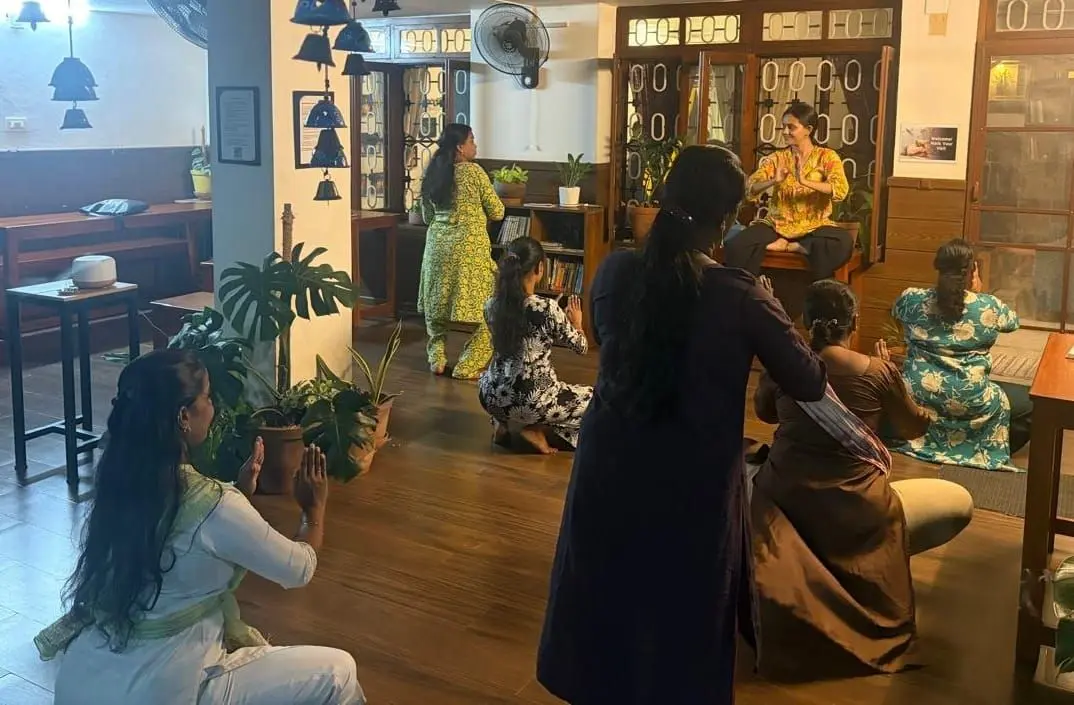
  • A group of people are gathered indoors on a wooden floor, sitting or kneeling with their hands pressed together in front of them. One person stands at the front wearing a bright yellow patterned top, facing the group. Others are dressed in various traditional-style garments in green, white, black and white, brown, and blue patterns. The room has potted plants, hanging decorative bells, a wall-mounted fan, and glass-paneled doors and windows in the background.

    Dancers built on steps learned in earlier sessions

    Students returned to dance practice on March 14, 2024. They worked on new steps and revised old ones. We saw them improve in coordination, rhythm and confidence. They seemed to enjoy it.
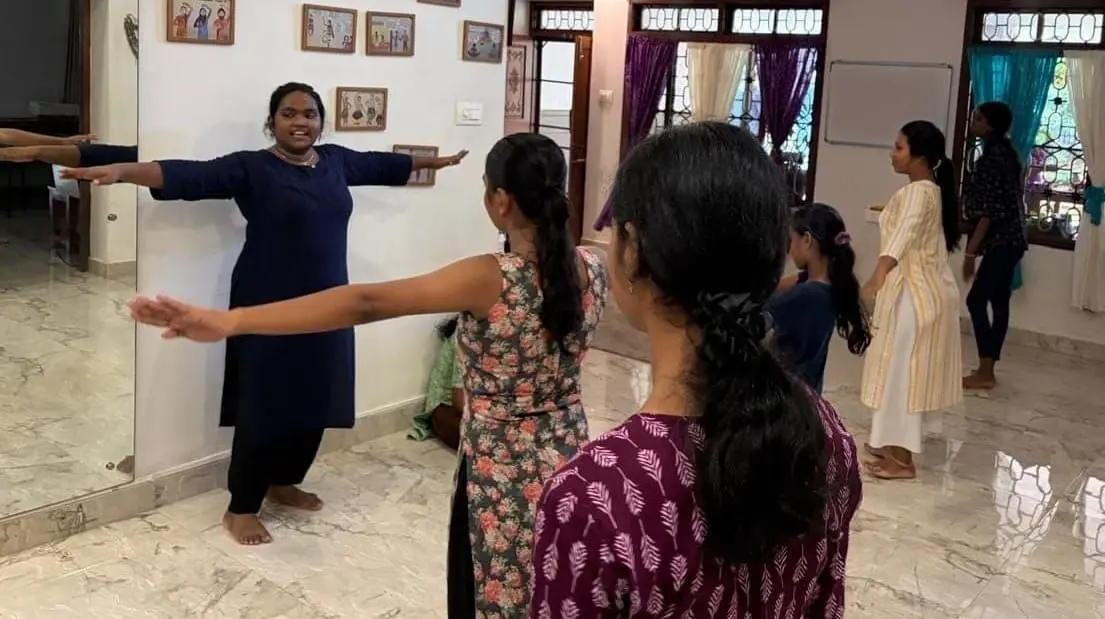
  • A woman in a dark blue outfit stands at the front of a room with her arms extended horizontally, leading a group of children who are mirroring her pose. The children, dressed in patterned and solid-colored clothing, stand in a line facing her. The room has a tiled floor, a large mirror along one wall, and framed pictures hanging on the wall behind the instructor. In the background, another adult stands near a doorway with stained glass panels and curtains.

    The young dancers worked on co-ordination and rhythm

    The young dancers kept working on their co-ordination, rhythm and expression. They did this with regular practice and gentle help. The sessions helped them build confidence. They enjoyed moving and learning together.
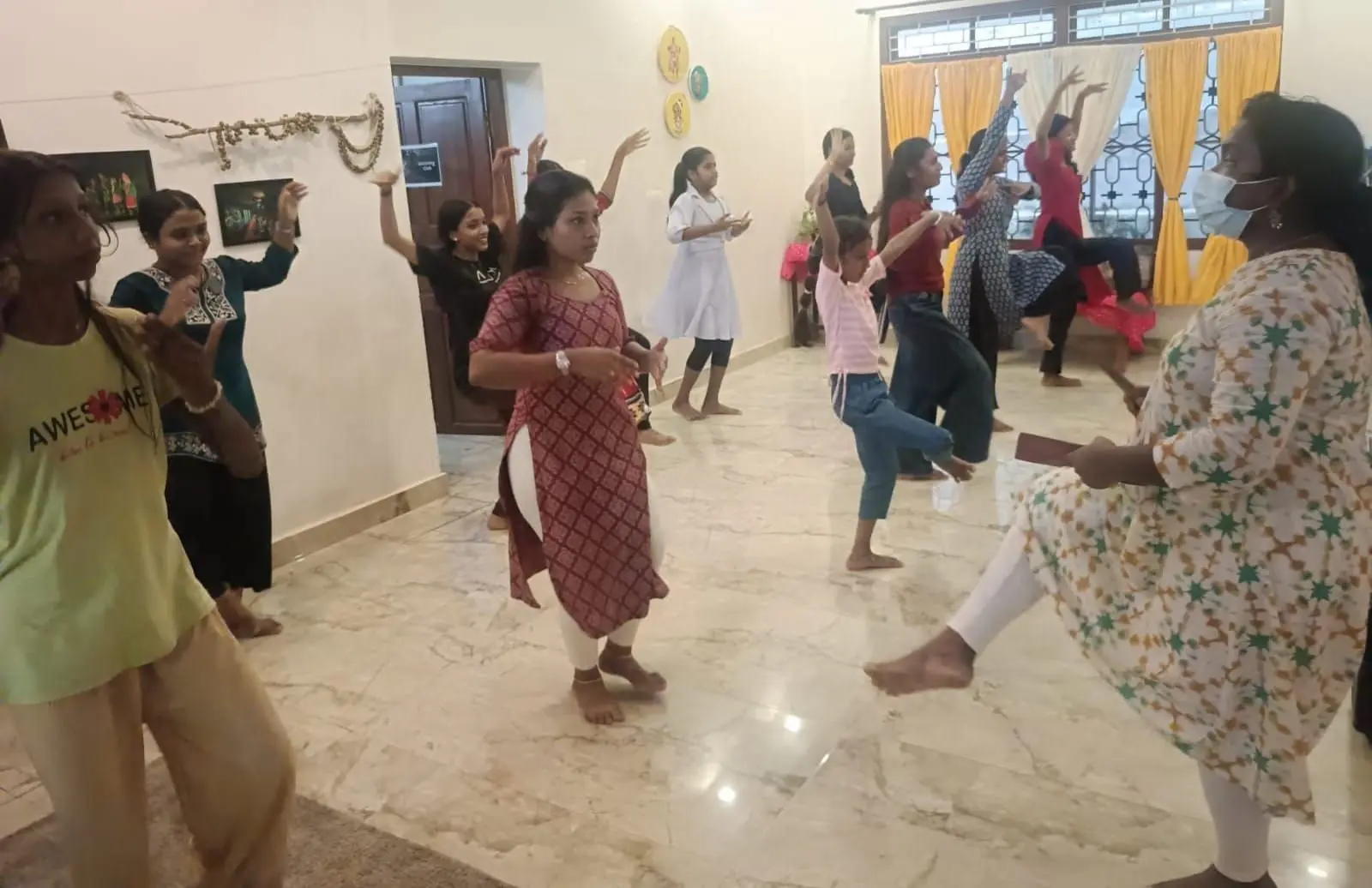
  • A group of people, including adults and children, are gathered indoors in a room with tiled floors and light-colored walls, performing synchronized movements with their arms raised and legs positioned as if dancing or exercising together. One person in the foreground wears a patterned dress and a face covering, while others wear casual clothing such as kurtas, t-shirts, and trousers. A doorway is visible in the background, along with wall decorations, a window with yellow curtains, and framed pictures on the walls.

    Children learn discipline and storytelling through Bharatanatyam

    The children learned discipline and how to tell a story through Bharatanatyam. We practised the steps, the facial expressions and co-ordination often. Their movements became more confident.
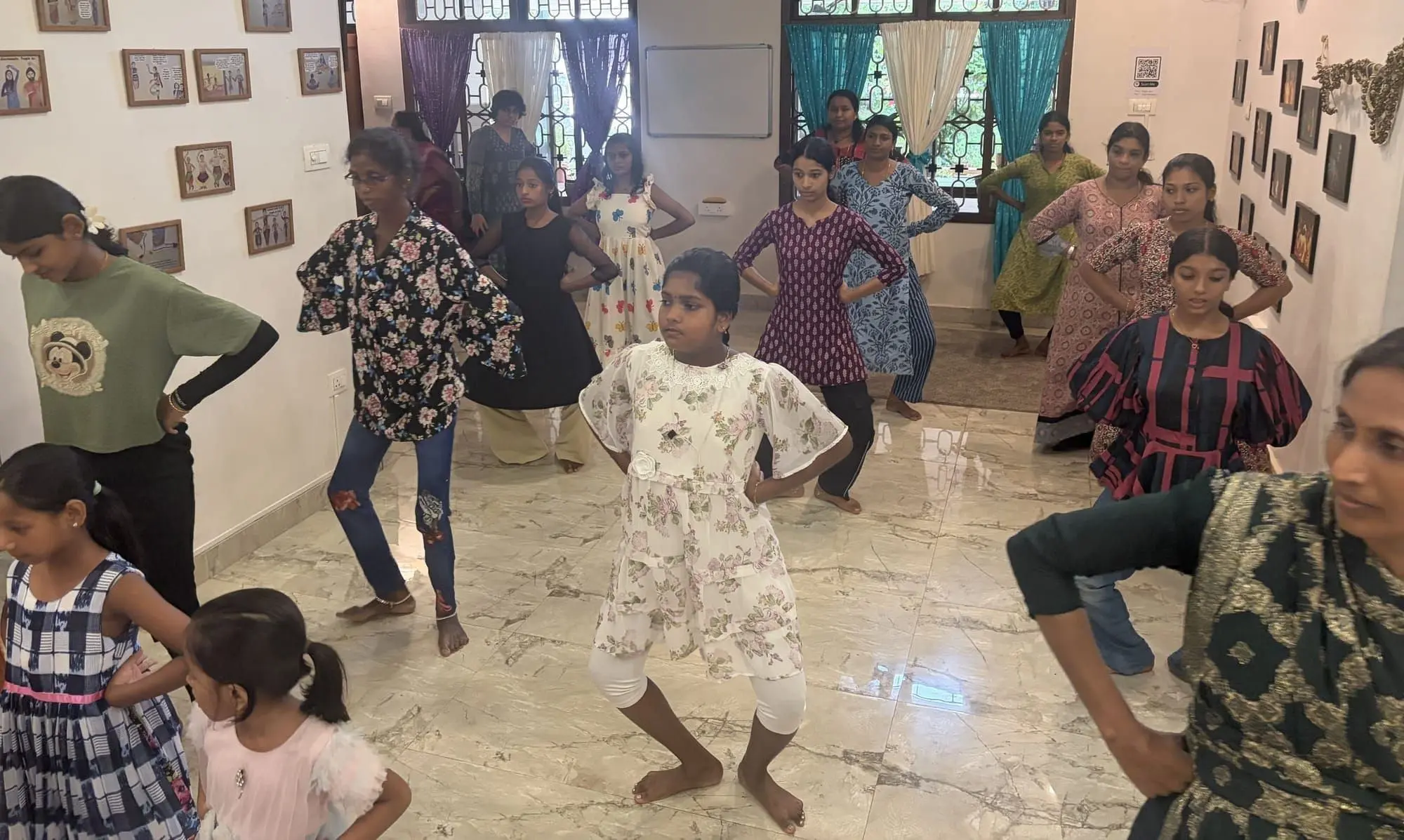
  • A group of children and adults are gathered in a room with tiled floors and framed pictures on the walls, standing in various poses with hands on hips or arms bent, some looking toward the camera while others look away, with windows covered by curtains visible in the background.

    Another day of Bharatanatyam practice for the children

    We held another Bharatanatyam class at the space. The children continued to learn movements and coordination together while building confidence and discipline.
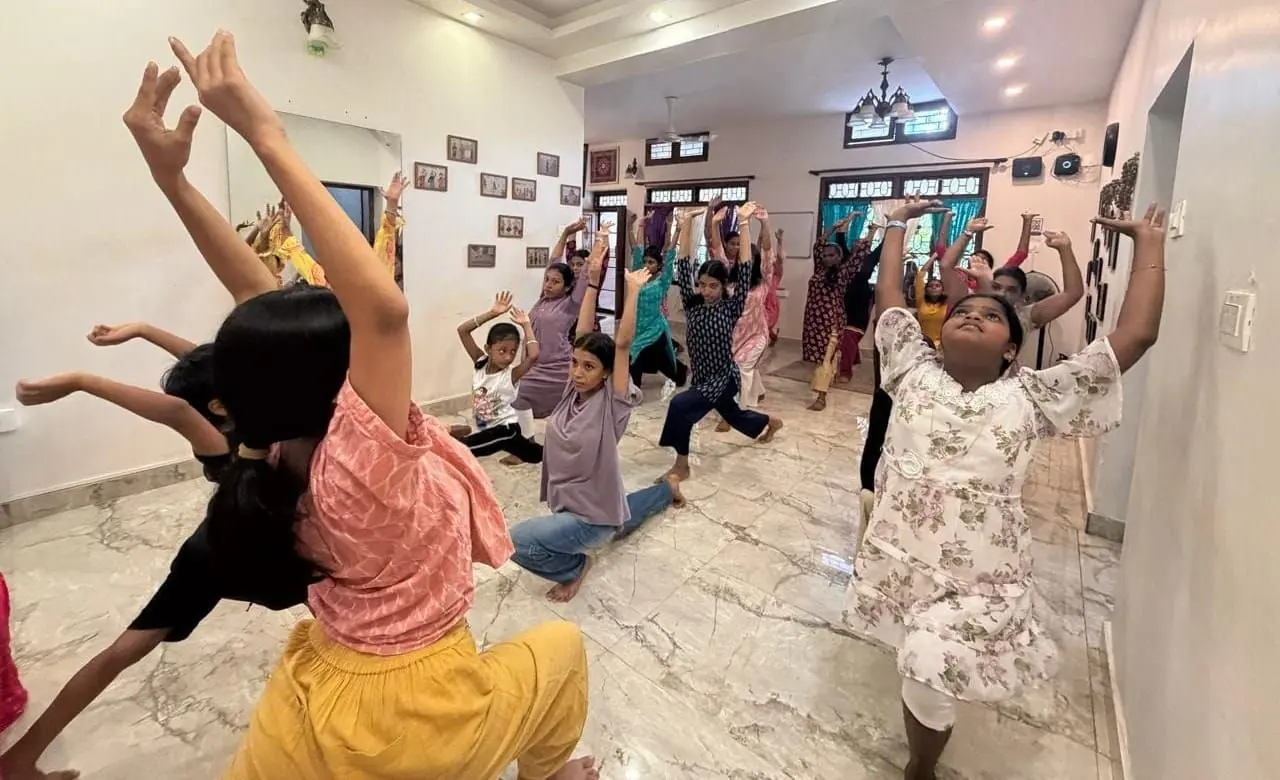
  • A group of children are practicing yoga poses inside a room with tiled floors and light-colored walls. In the foreground, one child in a pink top and yellow pants is in a lunge position with arms raised, while another child in a white floral dress mirrors the pose nearby. Other children are visible in the background, some kneeling and others standing, all with their arms extended upward. The room contains framed pictures on the wall, a mirror, and ceiling lights.

    Bharatanatyam students learned to tell stories without words

    The Bharatanatyam class was full of energy as students practiced expressions, postures, and movements together. With every step and hand gesture, the children learned how dance can tell stories without words.
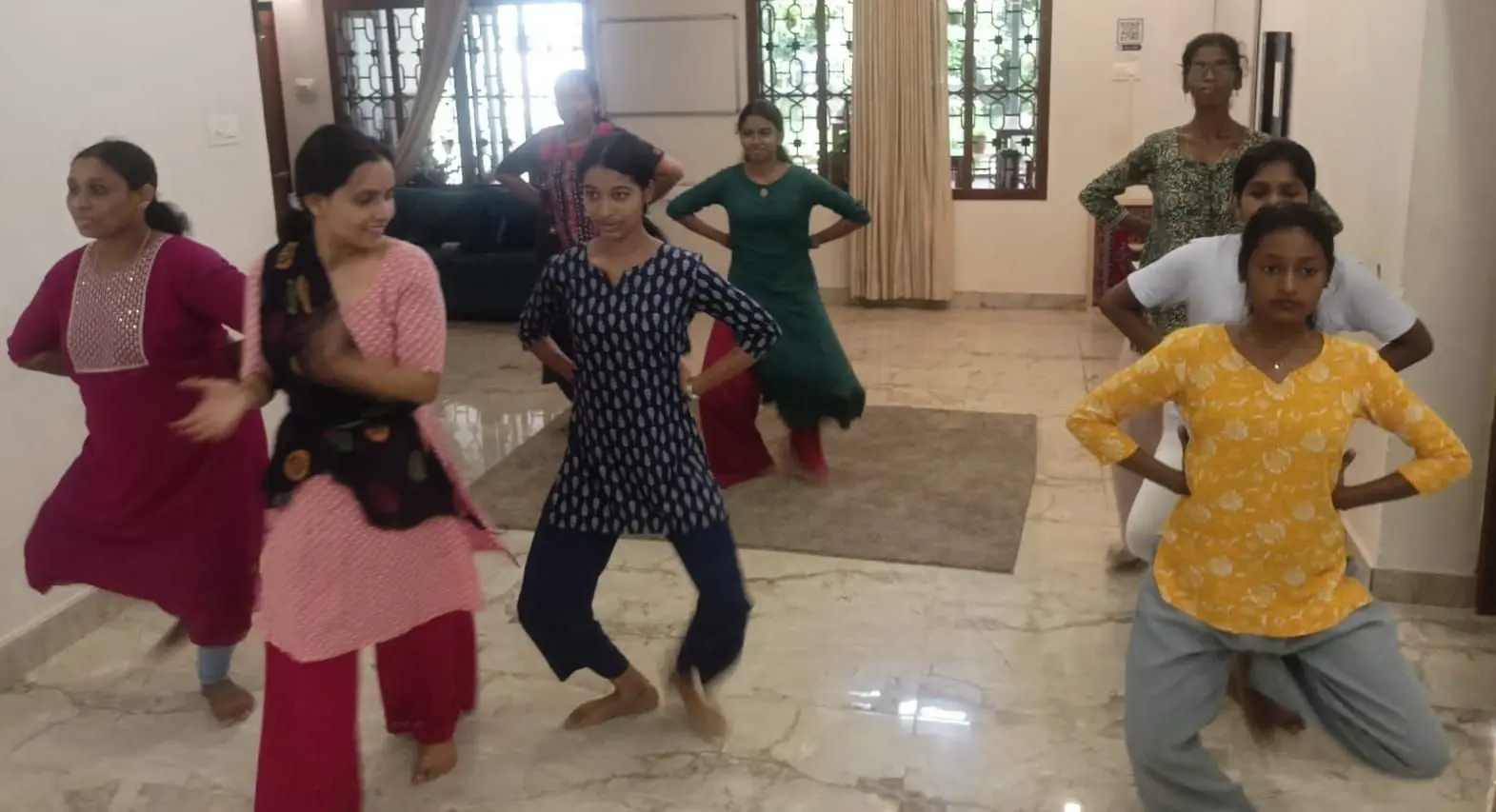
  • A group of women and girls are dancing indoors on a tiled floor, with one person standing on a rug in the center. They are wearing colorful traditional outfits, including dresses and tunics with pants, and are barefoot. Some are smiling and looking toward the camera while others look to the side. Behind them, there are windows with grilles, curtains, a sofa, and a wall-mounted object.

    Children and adults practised Bharatanatyam side by side

    The Bharatanatyam class brought children and community members together to practise steps, postures, and rhythm as a group. With every session, the space slowly grew into a place where learning, discipline, and art came together.
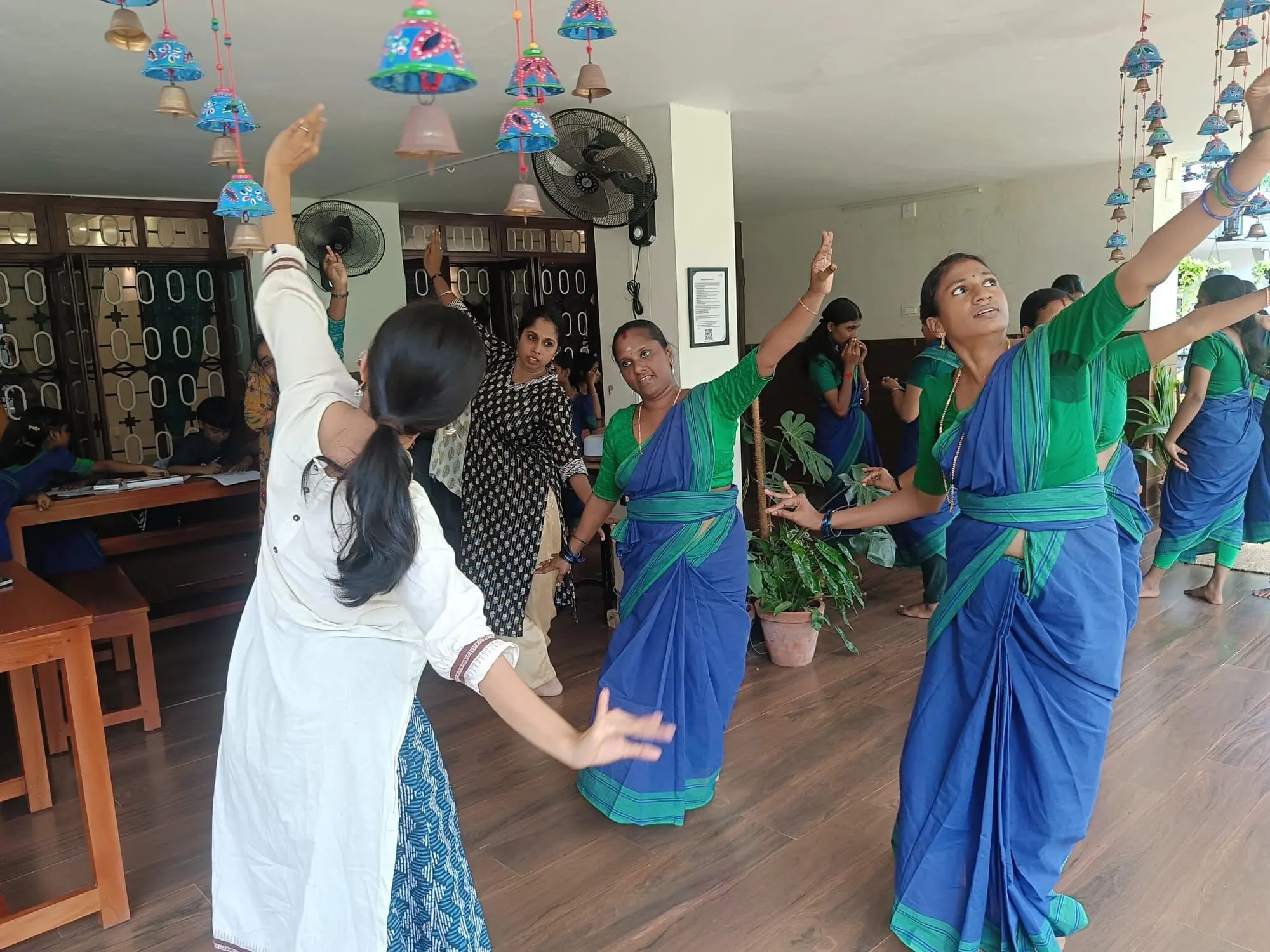
  • A group of women are dancing indoors on a wooden floor. Most wear blue and green sarees, while one woman in the foreground wears a white tunic with a patterned blue skirt. They have their arms raised and are smiling as they move. Hanging from the ceiling are colorful decorative bells and lamps. In the background, there are wooden tables and chairs, a standing fan, potted plants, and framed items on the wall.

    The Bharatanatyam class now runs in two batches

    The Bharatanatyam class now runs in two batches. Yesterday, five new students joined, bringing fresh energy as we continued to learn steps, rhythms, and expressions together.
  • A group of children are dancing in a studio with a mirrored wall, raising their arms and moving across a wooden floor.

    Fee-based dance class started with students

    We started a fee-based dance class on March 14, 2024, with students as part of the Change makers in Residence initiative. We did this to explore new ways of learning and growing within the space.
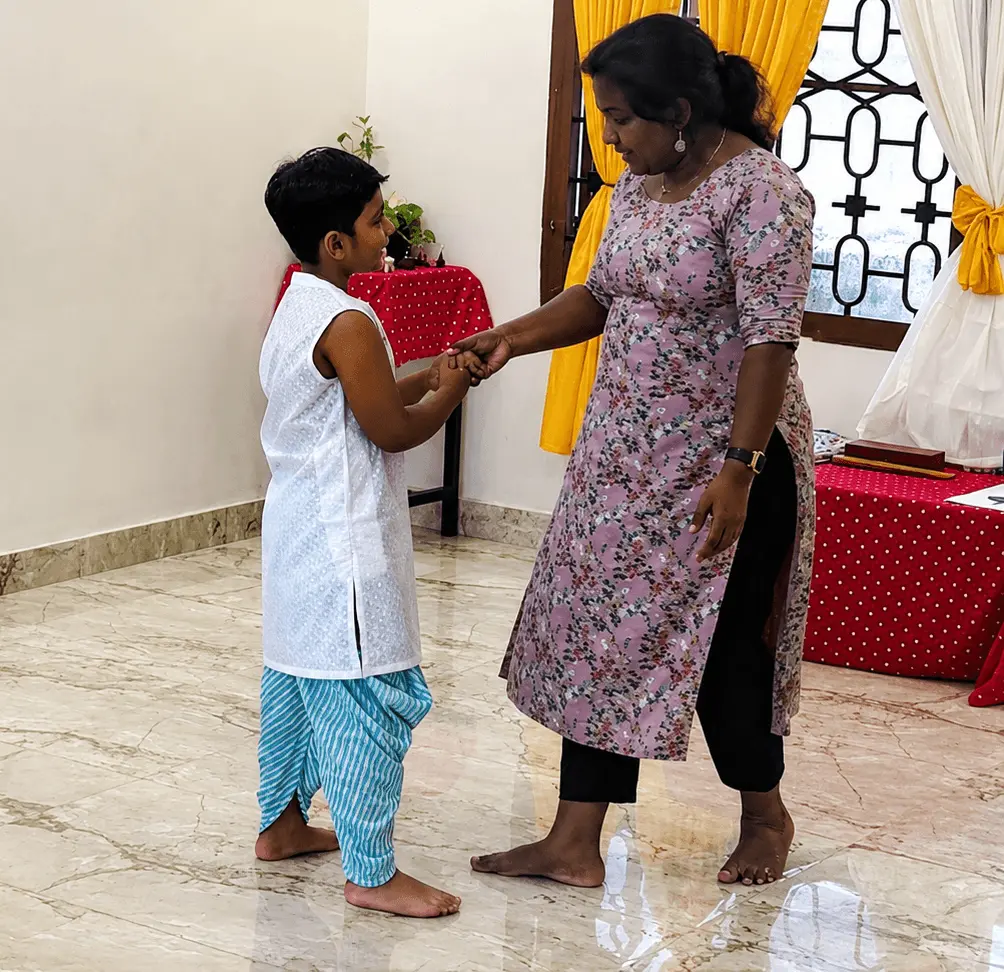
  • A woman in a long floral tunic and black trousers holds the hands of a young boy in a white sleeveless top and blue striped trousers. They stand barefoot on a polished tiled floor, facing each other indoors. Behind them, a table covered with a red cloth holds a small plant, and another red-covered table is visible near a window with yellow curtains and white drapes.

    Hand movements and expressions practised in dance class

    In the dance class, students practiced hand movements and expressions under guidance. With each correction and repetition, they slowly understood how every gesture tells a story.
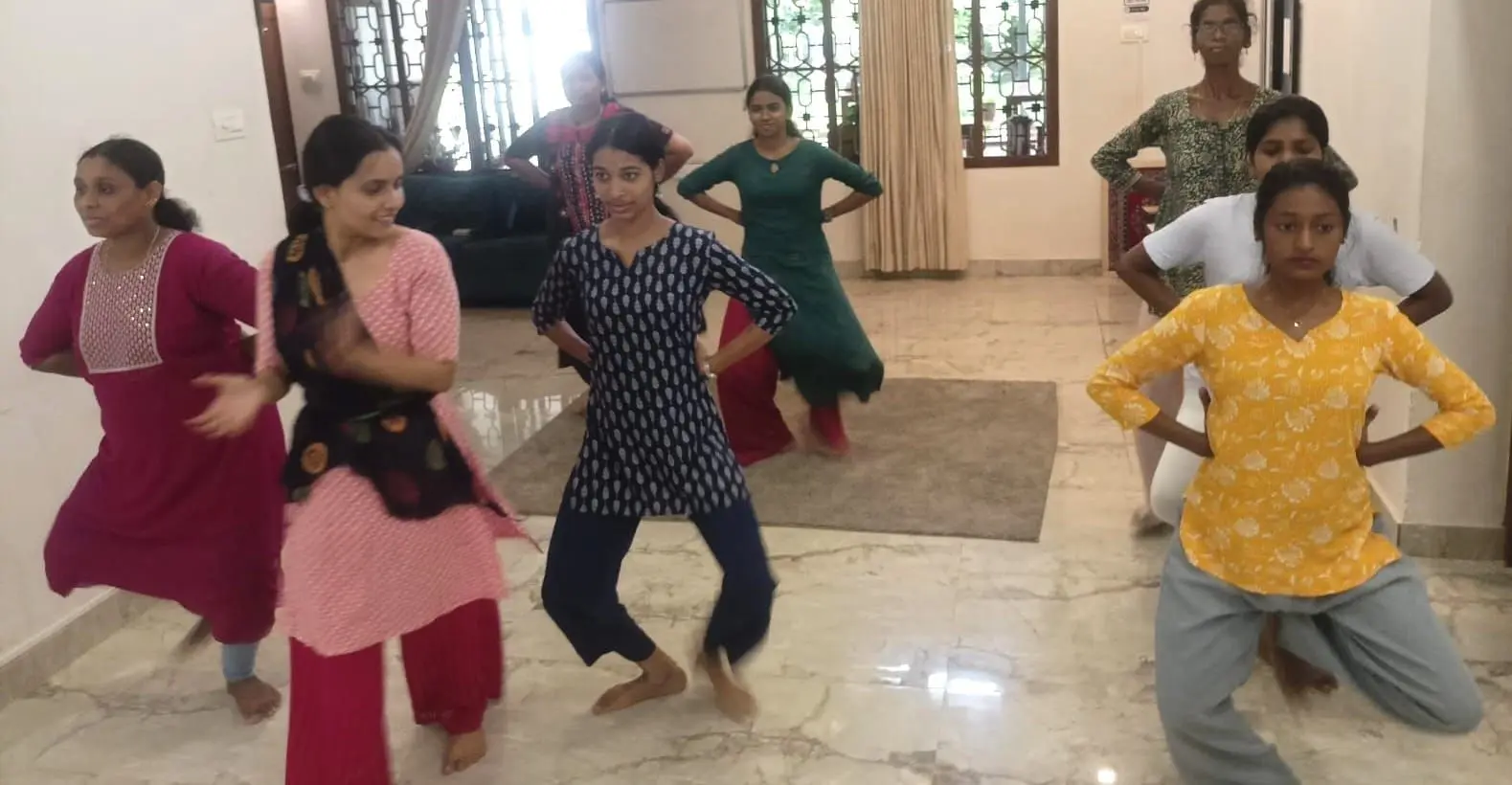
  • A group of women and girls are dancing indoors on a tiled floor, with one person standing on a rug in the background. They are wearing various colorful traditional outfits, including kurtas and salwar kameez, and are barefoot. Some have their hands on their hips while others have their arms extended, and they appear to be in mid-movement. Behind them are windows with grilles, curtains, and a sofa.

    Steps and body movements drilled in the Bharatanatyam class

    In the Bharatanatyam class, we practised together and focused on basic steps and body movements. With guidance and repetition, each movement slowly became more confident and expressive, bringing the dance to life.
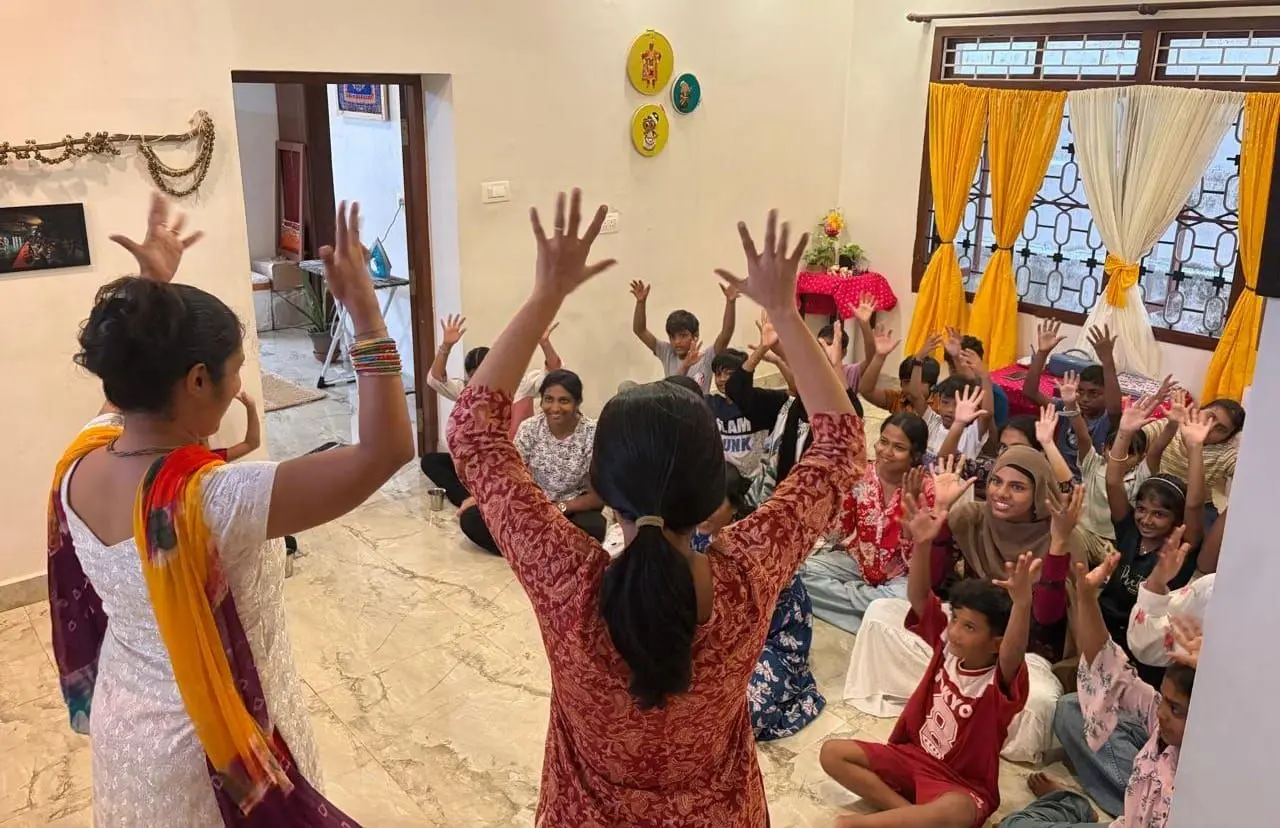
  • Two women stand with their backs to the camera, raising their hands in front of a large group of children who are sitting on the floor and also raising their hands. The room has light-colored walls and flooring, with a doorway visible in the background leading to another area. Yellow and white curtains hang over a window with a decorative grille. Several round decorative items are mounted on the wall above the group. A framed picture hangs on the wall to the left, and a decorative garland is draped nearby. The children are dressed in various casual clothes, and some wear head coverings.

    Expressions and gestures began to say something

    The question turned into a moment of learning. Expressions, gestures, and small movements began to show what was happening.
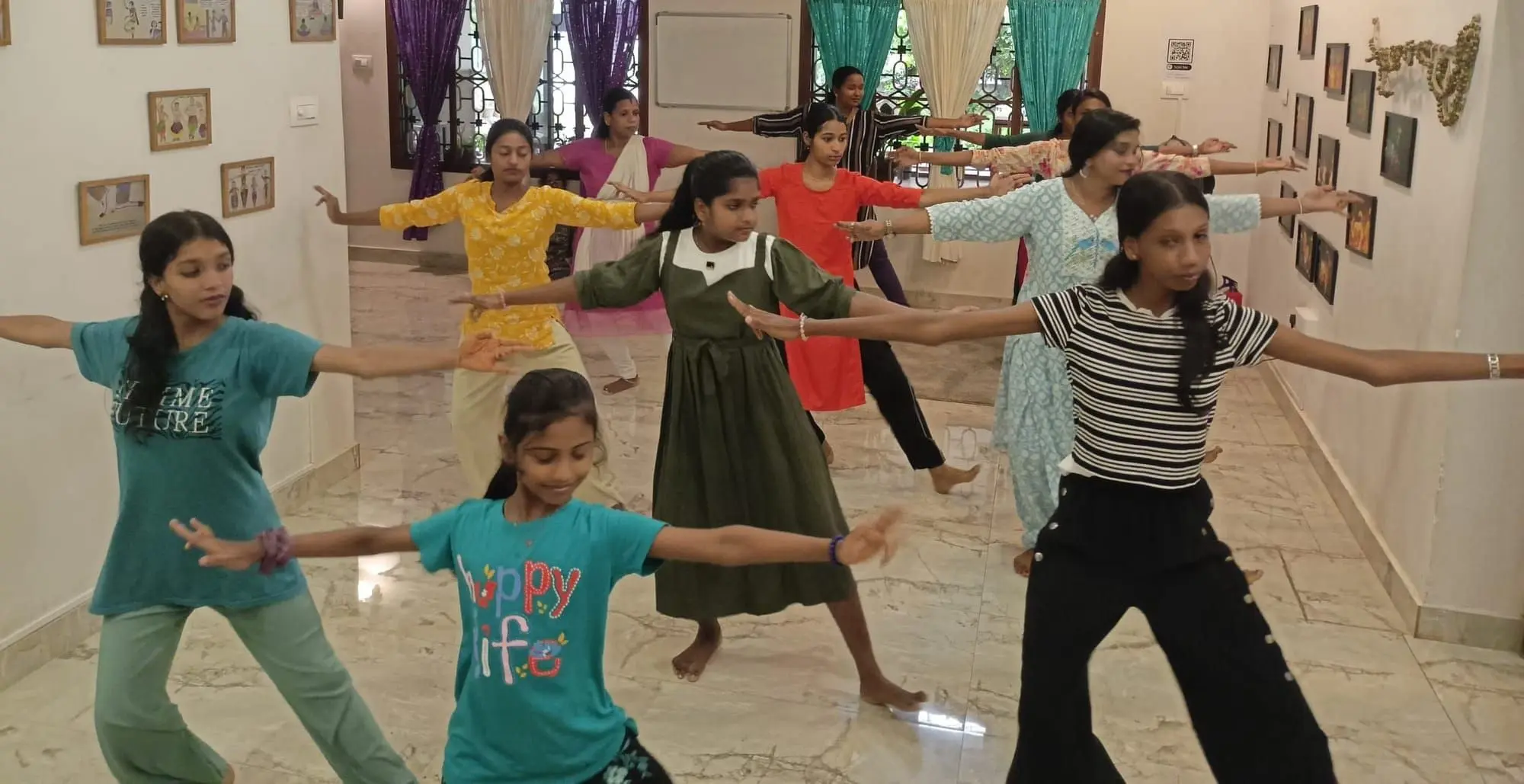
  • A group of girls and women stand in a line inside a room with tiled floors and framed pictures on the walls, all with their arms extended outward in a synchronized pose. They wear various casual outfits, including t-shirts, dresses, and traditional garments in colors like teal, yellow, green, red, and striped patterns. Some wear bracelets, and one person in the back holds a long object horizontally. The room has windows with patterned curtains and a whiteboard mounted on the wall.

    Community members practised basic Bharatanatyam steps

    Community members attended Bharatanatyam classes on March 14, 2024. We learned basic steps and practised together with focus and consistency.
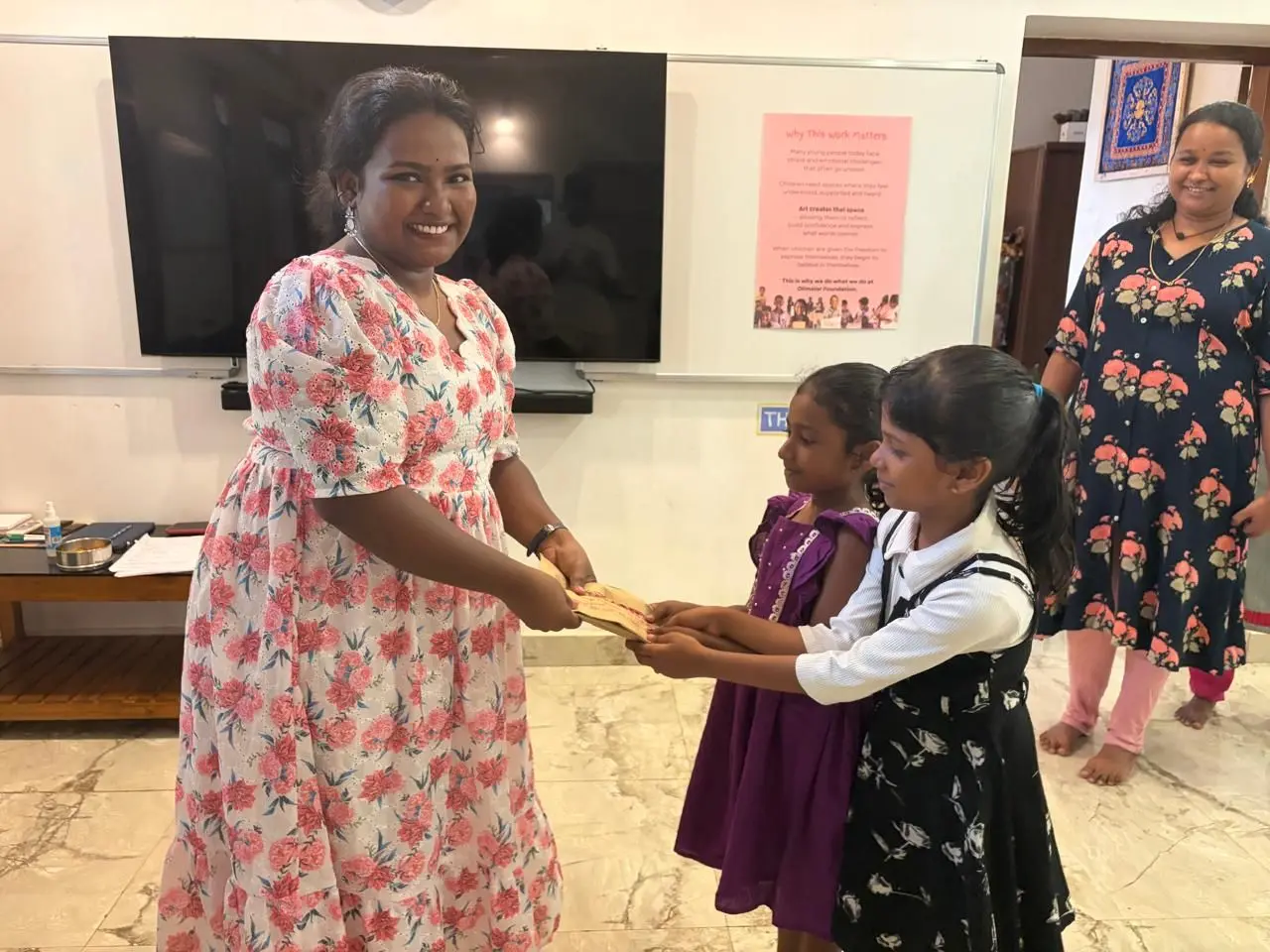
  • A woman in a floral dress hands a flat object to two young girls standing side by side, while another woman in a dark floral dress stands smiling in the background near a doorway. A television screen is mounted on the wall behind them, next to a whiteboard with a pink notice pinned to it. A wooden table with items on it sits to the left, and the floor is tiled.

    We celebrated the dance faculty's birthday after class

    Community members attended Bharatanatyam classes on March 14, 2024. We learned basic steps with focus and consistency. We also celebrated the faculty's birthday together after class.
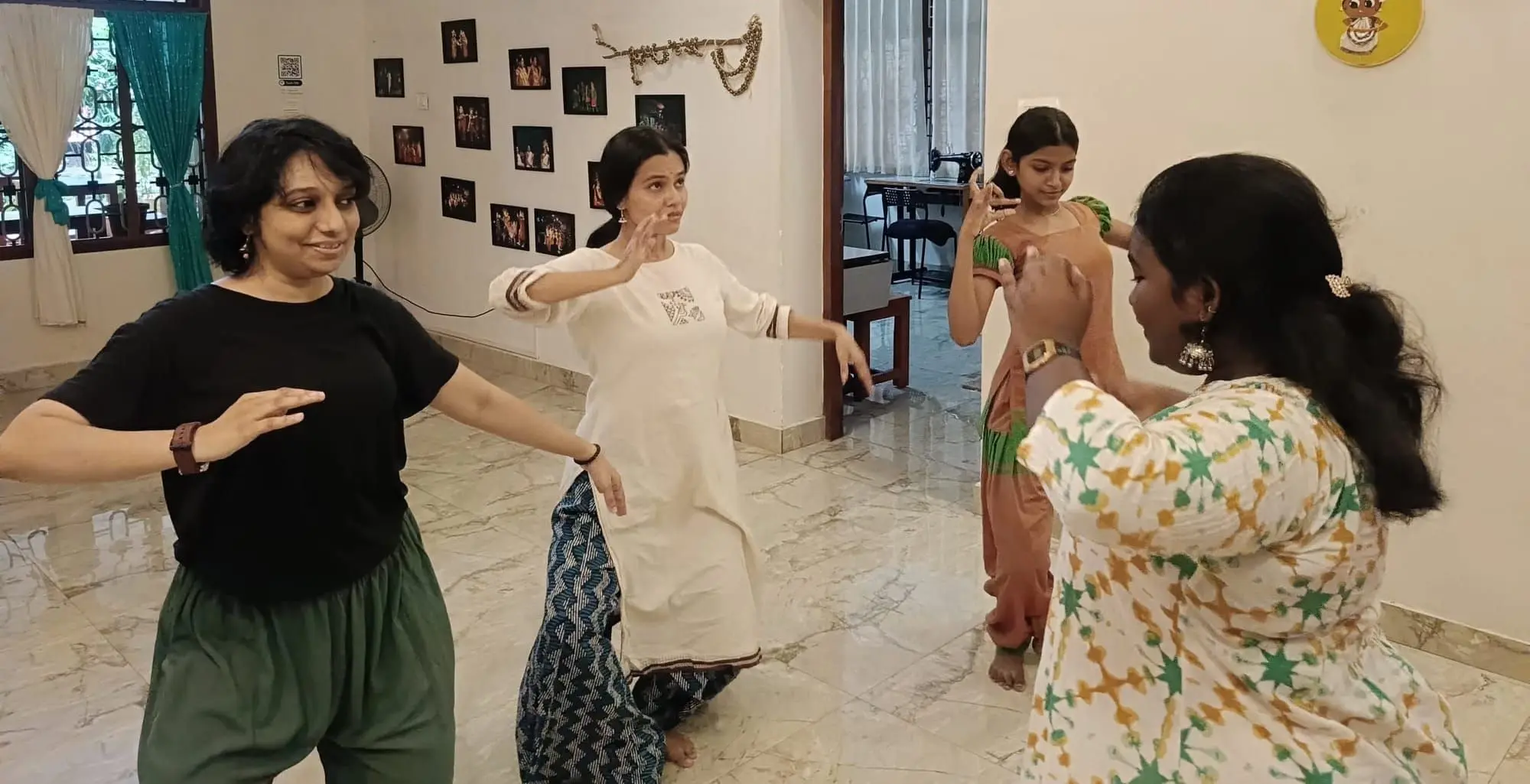
  • Four women are standing in a room with tiled floors and light-colored walls, arranged in a loose circle and facing one another. The woman on the far left wears a black short-sleeved top and loose green pants, with her arms extended forward at waist level. Next to her, a woman in a white long tunic and patterned blue pants stands with one arm raised and bent, her hand near her face. Behind her and slightly to the right, a younger girl in a peach-colored outfit with green trim stands with both hands raised near her head. On the far right, a woman in a white tunic patterned with green and orange stars faces the others, her hands raised in front of her. On the wall behind them, multiple framed pictures are arranged in a grid, and a decorative hanging piece is mounted above. A doorway in the background leads to another room where furniture is partially visible. A circular yellow decoration hangs on the wall to the right.

    Acting and expression added to the Bharatanatyam lessons

    We did acting and expression training as part of our Bharatanatyam lessons. We learned how to show emotions and tell stories with our faces and bodies.
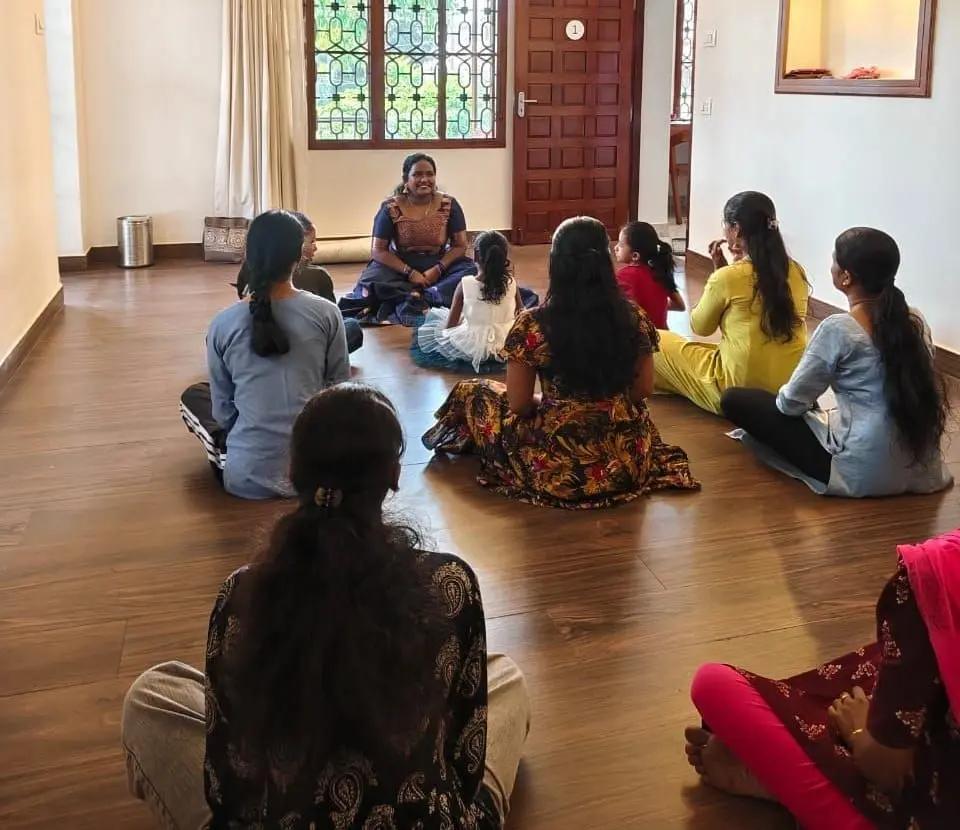
  • A group of people sit in a circle on a wooden floor inside a room, facing one person who sits at the head of the circle. The room has a large window with decorative glass panes, a wooden door with a number plate, and a shelf mounted on the wall. Some individuals wear patterned clothing, while others wear solid colors. A small child sits among the group. A metal bin and a woven basket are visible near the wall.

    Twenty-five students finished a long Bharatanatyam session

    25 students from Fort Kochi and Mattancherry finished a long, tiring yet beautiful Bharatanatyam session. Our esteemed faculty member, Aparna, led the session.