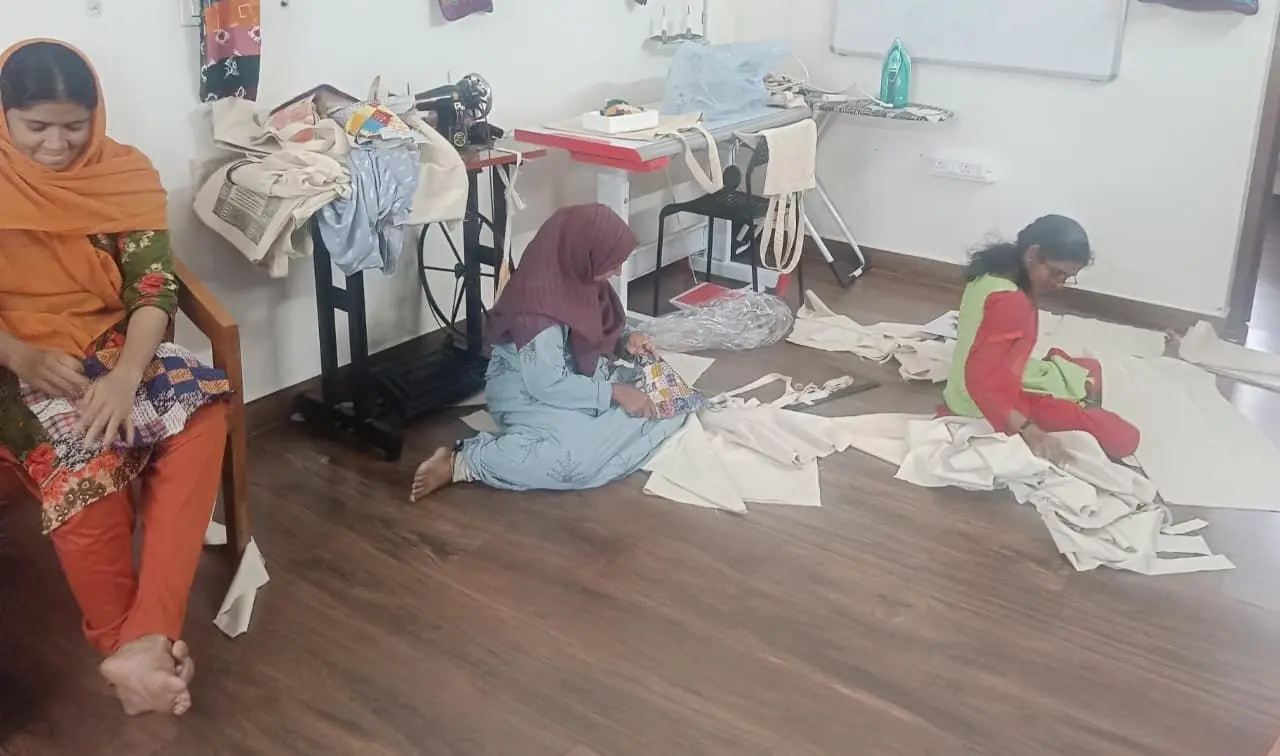
We conducted design experiments to improve the functionality and comfort of our tote bag handles. To evaluate aesthetic balance and physical usability, we stitched a prototype where one of the two handles was made slightly wider and longer. While the visual proportions looked promising, determining a single standardized handle length proved challenging because user heights and body types vary significantly. We briefly evaluated the idea of reducing the entire bag dimensions to balance shorter handles, but ultimately discarded that approach since the bag is already built to an established standard size and changing it would create unnecessary production complications.
To ensure the handle fits users of all heights without altering the core bag dimensions, we explored incorporating an adjustable strap mechanism. We selected sustainable strap buckles as a potential solution and planned a trial fitting to evaluate their usability, aesthetic integration, and practical handling. During our design review, we identified durability as a primary concern, particularly regarding machine washability. We noted that metal buckles pose a risk of rusting and permanently staining fabric panels during repeated wash cycles, while any alternative material must withstand tumbling and mechanical stress. Moving forward, we have defined baseline handle dimensions and are acquiring sustainable adjustable buckles to complete physical wash and wear testing before finalizing the component design.
Outcome
We conducted design experiments to improve the functionality and comfort of our tote bag handles. To evaluate aesthetic balance and physical usability, we stitched a prototype where one of the two handles was made slightly wider and longer. While the visual proportions looked promising, determining a single standardized handle length proved challenging because user heights and body types vary significantly. We briefly evaluated the idea of reducing the entire bag dimensions to balance shorter handles, but ultimately discarded that approach since the bag is already built to an established standard size and changing it would create unnecessary production complications.
To ensure the handle fits users of all heights without altering the core bag dimensions, we explored incorporating an adjustable strap mechanism. We selected sustainable strap buckles as a potential solution and planned a trial fitting to evaluate their usability, aesthetic integration, and practical handling. During our design review, we identified durability as a primary concern, particularly regarding machine washability. We noted that metal buckles pose a risk of rusting and permanently staining fabric panels during repeated wash cycles, while any alternative material must withstand tumbling and mechanical stress. Moving forward, we have defined baseline handle dimensions and are acquiring sustainable adjustable buckles to complete physical wash and wear testing before finalizing the component design.
Learnings
We conducted design experiments to improve the functionality and comfort of our tote bag handles. To evaluate aesthetic balance and physical usability, we stitched a prototype where one of the two handles was made slightly wider and longer. While the visual proportions looked promising, determining a single standardized handle length proved challenging because user heights and body types vary significantly. We briefly evaluated the idea of reducing the entire bag dimensions to balance shorter handles, but ultimately discarded that approach since the bag is already built to an established standard size and changing it would create unnecessary production complications.
To ensure the handle fits users of all heights without altering the core bag dimensions, we explored incorporating an adjustable strap mechanism. We selected sustainable strap buckles as a potential solution and planned a trial fitting to evaluate their usability, aesthetic integration, and practical handling. During our design review, we identified durability as a primary concern, particularly regarding machine washability. We noted that metal buckles pose a risk of rusting and permanently staining fabric panels during repeated wash cycles, while any alternative material must withstand tumbling and mechanical stress. Moving forward, we have defined baseline handle dimensions and are acquiring sustainable adjustable buckles to complete physical wash and wear testing before finalizing the component design.
Run this activity yourself. You are free to copy, change and share this write-up, as long as you credit aikyam space. Photos are not included. (Creative Commons licence CC BY 4.0)